FINDART

The Evangelists St Mark and St Luke

1635 · Private collection

religious

The painting, strongly influenced by Caravaggio, shows two of the Four Evangelists. Mark, seen to the left, looking directly at the viewer, is shown with the attribute of a lion and holding a large book with the words: 'Pax tibi, marce, evangelista mea' ('Peace be with you, Mark, my evangelist'), the words spoken by Christ when he visited him in prison. To the right, Luke is seen writing his gospel, with the ox, his attribute, beside him.
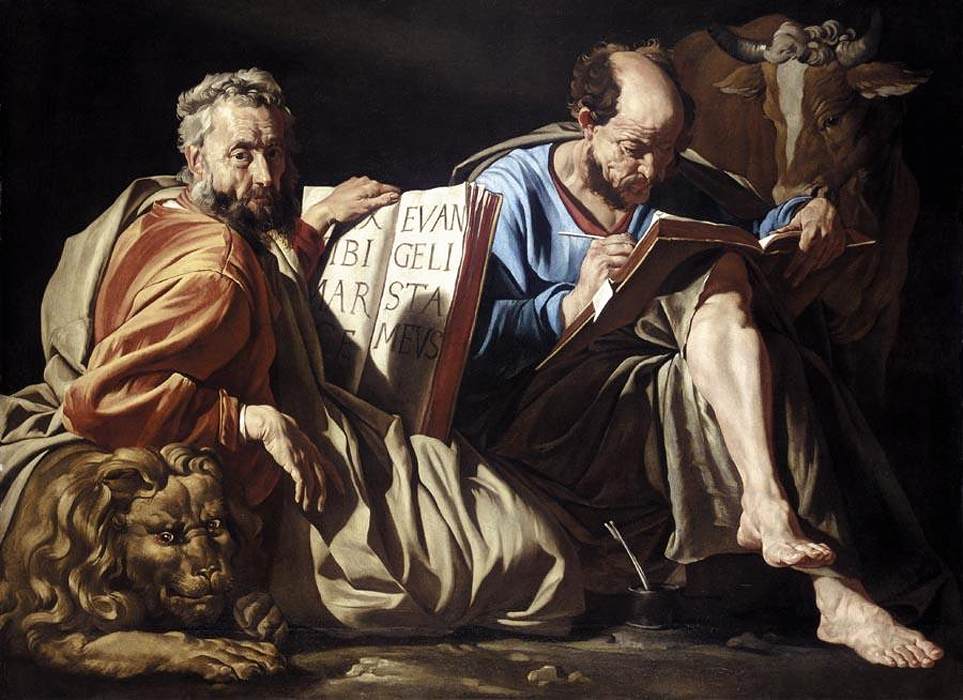
The Evangelists St Mark and St Luke

About the Artist

Matthias Stom

16001650

Matthias Stom (Stomer), Dutch painter, active in Italy. A document was discovered that firmly located Stom's birth in Amersfoort, but his family could have come from the southern Netherlands where the name Stom is fairly common. Although he is referred to as Stomer in art-historical literature, his few signed pictures bear some form of the name Stom, which form also appears in the few documents concerning the artist. It is often stated that he was a student of Gerrit van Honthorst in Utrecht, but this is unlikely since Stom must have started his training before 1620, the year in which van Honthorst returned from Italy. Matthias Stom traveled to Rome where he belonged to an important group of Caravaggisti (followers of Caravaggio) active there in the early seventeenth century. Like Caravaggio, they ranked naturalism and drama high in their pictorial subjects. He had established himself in the Eternal City by 1630. Later documents, such as the 1648 inventory of the collection of Don Antonio Ruffo, duke of Messina, place Stomer in Sicily, where he seems to have moved permanently sometime after 1632, following a stay of undetermined length in Naples. The hallmark of Stom's art is his personal interpretation of the Caravaggesque idiom. This stylistic vocabulary, learned initially from the Northern followers of Caravaggio and then experienced firsthand in Rome, was further enhanced by Stom's access to the later works of Caravaggio decorating churches in Naples and Sicily. Of Stom's surviving works only the Saint Isidore Agricola of 1641, formerly in the church of Caccamo near Palermo, is securely dated. Consequently, the chronology of his paintings has been established largely on the basis of their internal evidence.

View all works →