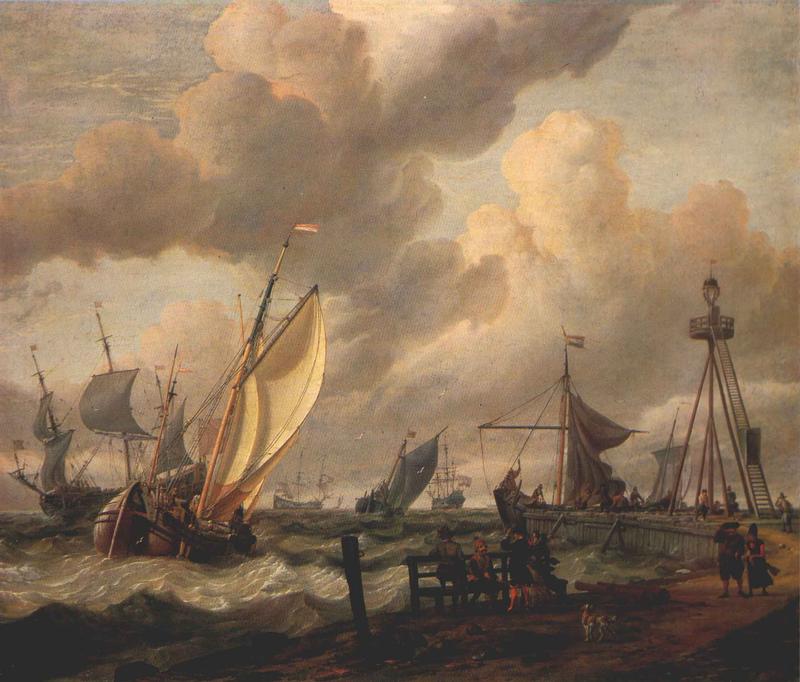
Abraham Storck
1644 – 1708
Painter, member of a family of Dutch painters. No paintings are known by the Amsterdam painter Jan Jansz. Sturck, who later changed his name to Sturckenburch, but he had three sons, all painters, who used the name Sturckenburch until c. 1688, later calling themselves Storck or Sturck. There are no surviving works by the eldest son, Johannes (c. 1630-1673). Abraham Storck, the youngest, was the best known of the three artists. He was a versatile artist, renowned for his marine paintings, topographical views and Italianate harbour scenes. His brother Jacobus Storck painted similar subjects, but his works are fewer and less accomplished. Both brothers' pictures are mainly of a modest size and painted on canvas more often than on panel. Abraham trained and worked with his father and became a member of the Guild of St Luke in Amsterdam. In 1694 he married Neeltje Pieters van Meyservelt, a surgeon's widow. His river and coastal scenes were greatly influenced by Ludolf Bakhuysen in the pictorial treatment of sky and water, as, for example, in the Shipping Scene (Dublin, National Gallery) and the Roads of Enkhuizen (Amsterdam, Rijksmuseum, 1521). Abraham also absorbed influences from other well-known Amsterdam marine painters, notably Willem van de Velde the Younger and Jan Abrahamsz. Beerstraten. The Beerstraten and Storck families were close friends and distantly related by marriage. In his paintings of sea battles Abraham emulated Jan Beerstraten's somewhat crowded and agitated compositions.
View all works →