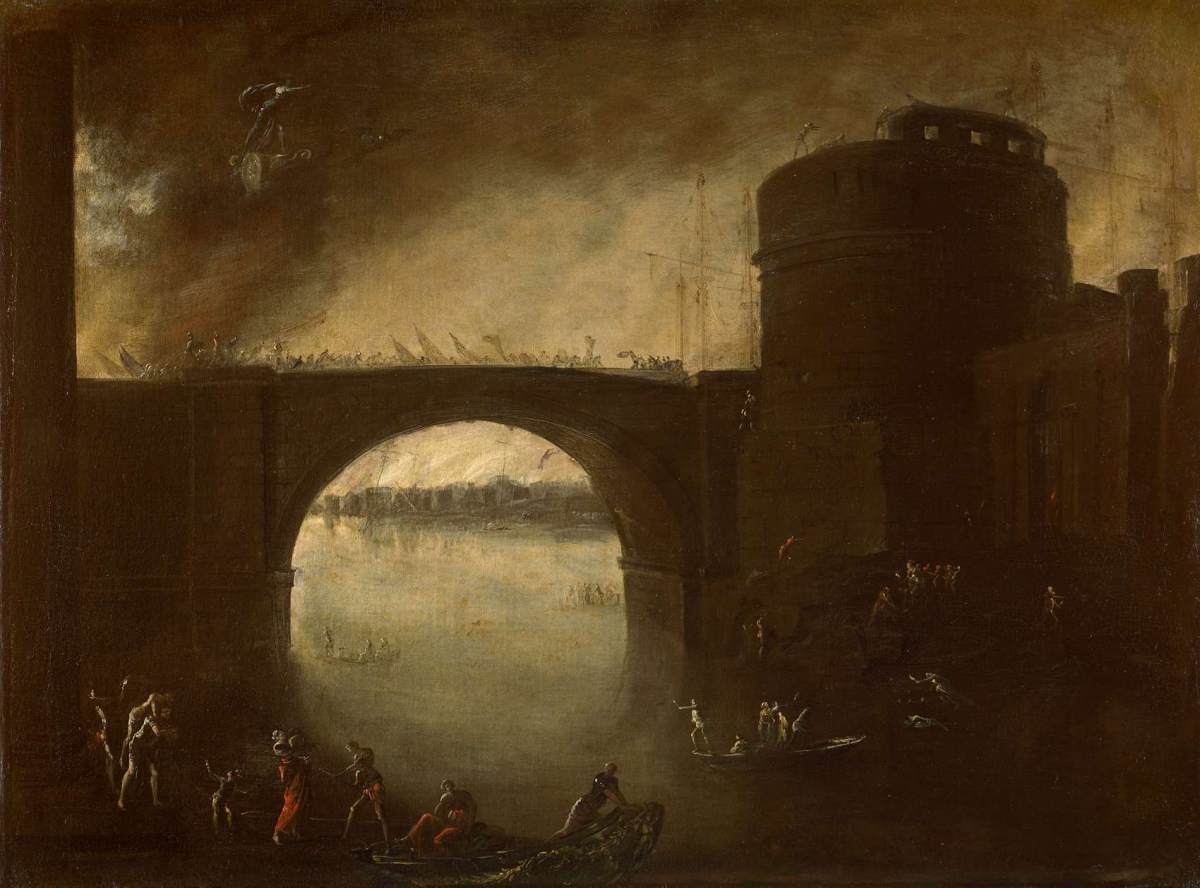
Agostino Tassi
1578 – 1644
The son of a furrier named Domenico Tassi, Agostino Tassi, who aspired to nobility, invented the story of his adoption by the Marchese Tassi. When still young he left Rome for Tuscany where he was employed by the Medici perhaps briefly in Florence and for many years in Livorno. In all likelihood his long stay there, interrupted by visits to Rome in 1599 and to Genoa in 1606, was at least in part dictated by punishment for a crime. Little is known of his artistic formation, which probably included contact with Paul Bril and Giulio Parigi. Tassi returned to Rome in late 1610. There, under the direction of Cigoli, he executed a frieze of landscapes and seascapes in Palazzo Firenze (lost). Frescoes in the Palazzo del Quirinale (1611-12), also lost, established Tassi's reputation as Rome's foremost painter of illusionistic architectural decoration. These were commissioned by Pope Paul V and produced with Orazio Gentileschi, who was responsible for the figures. The two also painted frescoes for Cardinal Scipione Borghese in the Casino delle Muse. In 1616-17 Tassi again painted in the Palazzo del Quirinale, with Giovanni Lanfranco and Carlo Saraceni, in the Sala Regia. In 1621 Tassi collaborated with Guercino in the Casino of the Villa Ludovisi, where he created the illusion of tremendous height in relatively low-vaulted spaces. From 1617 to 1625 or later he was engaged in the decoration of several rooms in the Palazzo Lancelotti, which included an elaborate illusionistic architectural setting for the salone and smaller landscapes with scenes from Torquato Tasso's epic poem Gerusalemme Liberata for one of the rooms on the ground floor. In his later career he seems to have abandoned illusionistic architecture in favour of landscape. His last known project is the frieze of Moses in Palazzo Pamphilj in Piazza Navona, painted with Angelo Caroselli and Francesco Lauri, elder brother of Filippo. Although Tassi was better known as a fresco painter he also executed canvases, which range from the small Arrival of the Queen of Sheba before Solomon (c. 1610, Burghley House, Lincolnshire) to the huge Entry of Taddeo Barberini from the Porta del Popolo (1632, Banca di Roma, Rome). Furthermore he is remembered as the master of Claude Lorrain and for having been convicted in 1612 of the rape of Artemisia Gentileschi, the daughter of his partner Orazio.
View all works →