David the Younger Teniers
1610 – 1690
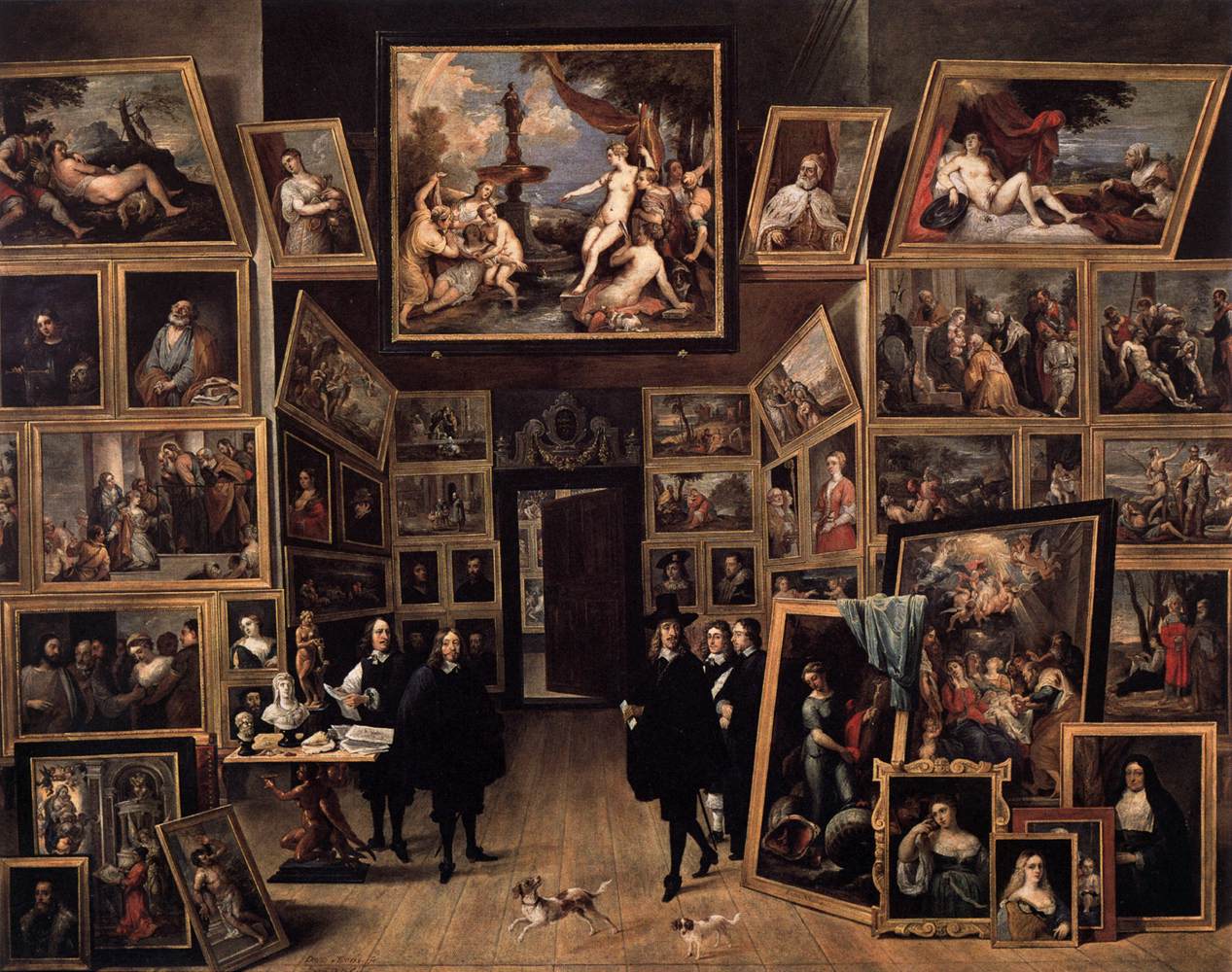
Prolific Flemish painter of the Baroque period known for his genre scenes of peasant life. He was the son and pupil of David Teniers the Elder. In 1637 he married Anna, daughter of the painter Jan Brueghel the Elder. Teniers painted almost every kind of picture, but chiefly genre scenes of peasant life, many of which were subsequently used for tapestry designs in the 18th century. His early works in this vein show the influence of Adriaen Brouwer (e.g., Twelfth-night, Museo del Prado, Madrid). Many of his finer works date from 1640 to 1650. He was brilliant at handling crowd scenes in an open landscape and adept at characterizing his figures with a warm, human, and often humorous touch (e.g., The Village Fête, 1646; Hermitage, St. Petersburg). His landscape settings are atmospheric, and his still-life details precise. In the same decade he also painted a number of monumental processions (e.g., Procession of the Antwerp Civic Guards, 1643; Hermitage, St. Petersburg). Teniers developed a second career in 1651 when he moved to Brussels, becoming court painter and keeper of the art collections to the regent of the Netherlands, the archduke Leopold William. He painted several views of the Archduke's picture gallery. He also made many small-scale individual copies of paintings in the Duke's collection by foreign artists, especially Italians. Of these, 244 were engraved in 1660 under the title Theatrum Pictorium. As a pictorial inventory of a great 17th-century collection, this book of engravings was unique in its time and still constitutes a valuable source for the art historian. Teniers was also court painter to Don John of Austria, who succeeded the Archduke as regent in 1656, and was one of the prime movers in the foundation of the Brussels Academy of Fine Arts (1663) and subsequently the Academy in Antwerp (1665). Teniers' son, also named David (1638-85), often imitated his father's work. There are several of his altarpieces in churches in Belgium.
View all works →