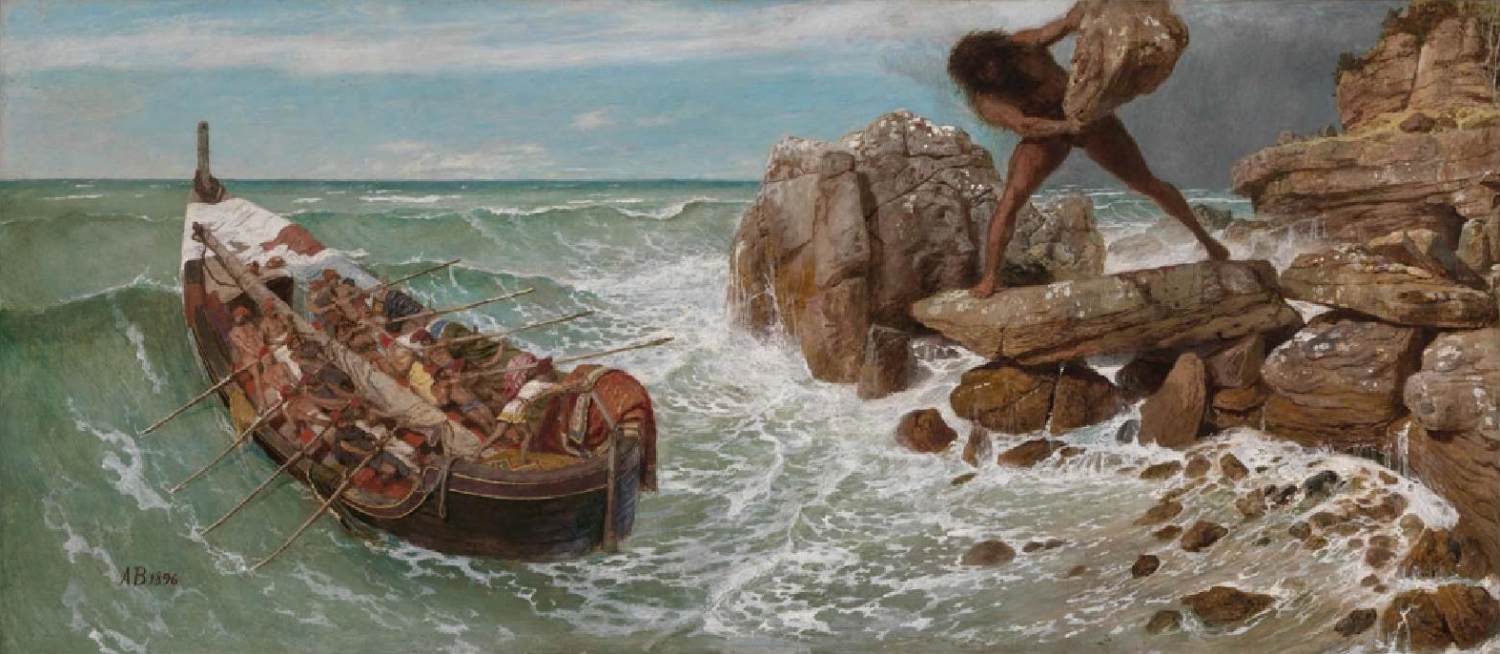
Arnold Böcklin
1827 – 1901
Swiss painter. He was, with Ferdinand Hodler the major Swiss painter of the 19th century, and he exerted a great influence on the German-speaking countries through the expression of a heightened Romanticism and poeticism. He was trained in Germany, Flanders, and Paris, and spent seven years in Rome (1850-57), where he transformed his early naturalistic landscapes, more or less in the manner of Corot, into symbolic subjects with figures epitomizing the mood of the landscape. In the 1860s he visited Pompeii, where the ancient Roman frescoes led him to attempt classical history subjects, often harsh in colour. He married an Italian orphan named Angela. Their Catholic union created endless problems in the Protestant painter's hometown even though the couple mostly lived in Florence and Rome. Angela, who bore Böcklin eighteen children, resolutely opposed his working from any female model than herself. In 1866 he resided at Basle. He was in Munich in 1871-74, in 1885 in Hottingen (Switzerland). However, like other German artists of the period, he spent much of rest of his life in Italy, where he died in Fiesole near Florence. The work by which he is best known, The Island of the Dead, was first painted when he was living in Florence (1874-85) and was repeated in many versions. This painting partly evokes the English Cemetery, Florence, close to his studio and where his baby daughter Maria had been buried. It has a curiously haunted quality; the same quality can be found in his Pan (which also exists in several versions) and in some other landscapes. Most of his works are in his native Basle, where the Museum has a frescoed staircase and in Munich and other German museums.
View all works →