Jan Toorop
1858 – 1928
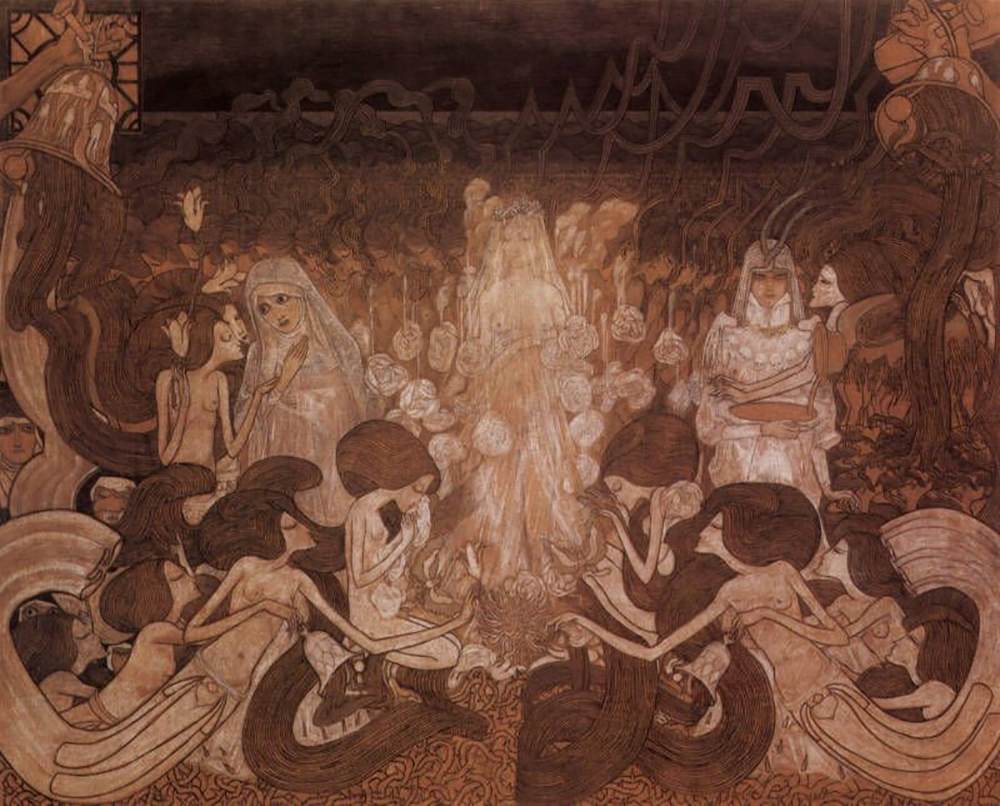
Dutch painter. He was born in Purworejo, Java, Dutch East Indies, in 1872, he moved with his family to the Netherlands. He took a course in drawing at the Polytechnische School in Delft (1876-79). He also studied at the Rijksakademie voor Beeldende Kunsten in Amsterdam (1880-82) and at the Ecole des Arts Décoratifs in Brussels (1882-85). In Amsterdam he joined the St Lukas Society, and in Belgium he was a founder-member of Les XX in 1884. Although he had met Jozef Israëls in 1880 and respected the style of the Hague School, he was more attracted by what he saw in Brussels, particularly work by French artists. His portraits of 1884 are painted in an Impressionist style. With other members of Les XX he trained himself in plein-air; he learnt from James Ensor how to apply colours with a palette knife and how to use white with the same intensity as other colours. His style, however, remained austere and his scenes of workmen show a sensitive realism reminiscent of Gustave Courbet 's work. During his years in Brussels, Toorop worked in various styles, such as Realism, Impressionism, Neo-Impressionism and Post-Impressionism. After his marriage to an Annie Hall, a British woman, in 1886, Toorop alternated his time between The Hague, England and Brussels, and after 1890 also the Dutch seaside town of Katwijk aan Zee. During this period he developed his own unique Symbolist style, with dynamic, unpredictable lines based on Javanese motifs, highly stylised willowy figures, and curvilinear designs. Thereafter he turned to Art Nouveau styles, in which a similar play of lines is used for decorative purposes, without any apparent symbolic meaning. In 1905 he converted to Catholicism and began producing religious works. He also created book illustrations, posters, and stained glass designs.
View all works →