FINDART

The Lamentation over the Dead Christ

1617 · Galleria Borghese, Rome

religious

Although often included among the ranks of the followers of Caravaggio in Rome, a grouping which the nocturnal effects of the Lamentation make plausible, Turchi in fact exercised considerable independence in his choice of sources and influences. Painted in 1617, only a few years after he left his native Verona and settled in Rome, the work reveals a surprisingly strong classicising tendency, despite the use of artificial illumination and dramatic contrasts of light and shade. Part of the Caravaggesque quality here, however, is a product of two very specific elements, the use of slate as a support and the artificial illumination.

Loading map…
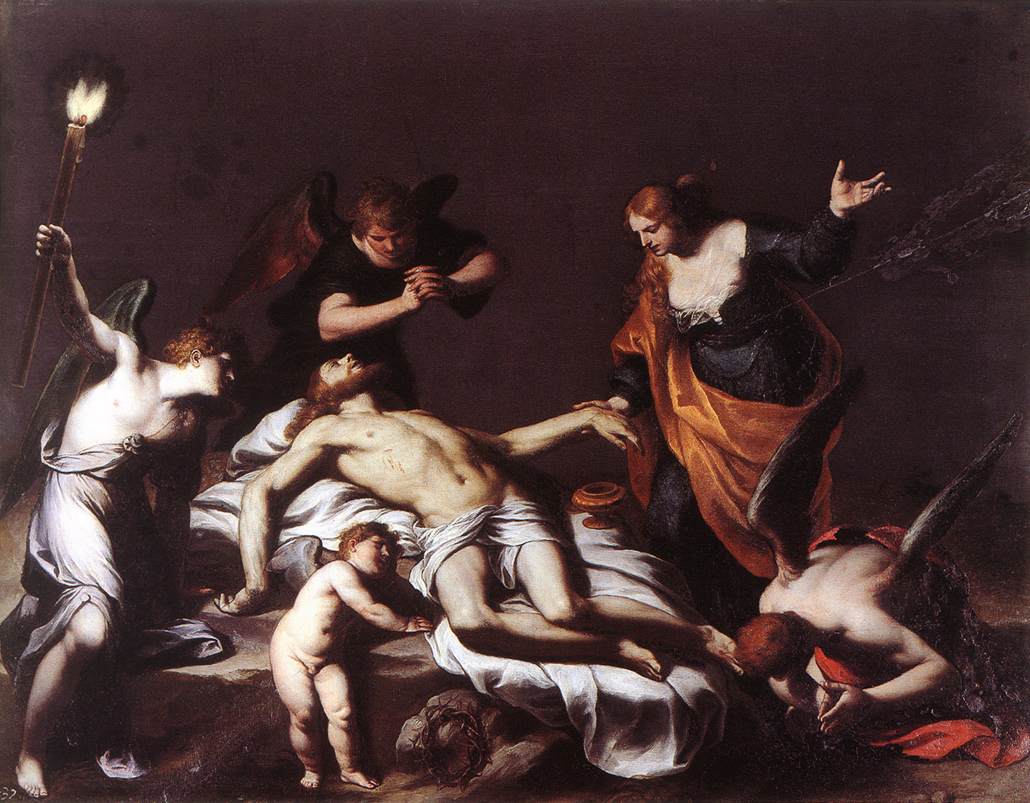
The Lamentation over the Dead Christ

About the Artist

Alessandro Turchi

15781649

Italian painter called l'Orbetto, also known as Alessandro Veronese. He gained his nickname l'Orbetto from guiding his father who took to begging after becoming blind ('orbo' in Italian). Recorded in 1597 as a member of Felice Brusasorci 's studio, Alessandro worked in an idiom that reflected Veronese painting traditions, completing commissions for local churches after his master's death in 1605. The following year he was appointed to decorate the organ shutters of the Accademia Filharmonica, one of the city's most prestigious institutions, and soon became a member of this cultural élite as successor to Brusasorzi. During these early years he may have travelled to Mantua and Venice. In Rome around 1614, he painted an impressive oval panel as part of the decoration of the Sala Regia in the Palazzo del Quirinale. In 1616 Cardinal Scipione Borghese paid Alessandro for frescoes in the Casino del Barco at the Villa Pinciana (now destroyed) and acquired some works on slate the following year. As a member of the Accademia di San Luca from 1618, Turchi took an active interest in the running of the institution; this culminated in his election as 'principe' in 1637 and his affiliation to the Virtuosi del Pantheon a year later. As well as painting altarpieces for Roman churches, his work also attracted collectors in France. His polished mythological and religious subjects were collected by art lovers. Turchi maintained fruitful connections with Verona throughout his career.

View all works →