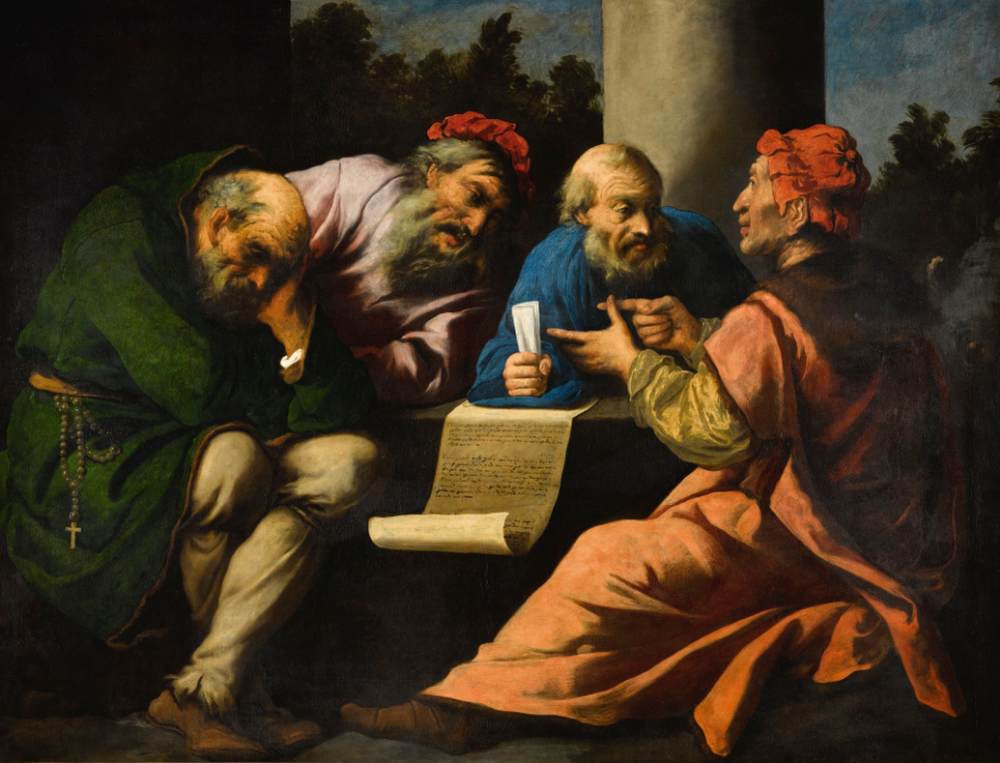
Pietro della Vecchia
1602 – 1678
Italian painter. Until 1984 he was mentioned as Pietro Muttoni, called della Vecchia. However, this description was founded on a misunderstanding created by Lanzi, who in his Storia pittorica della Italia confused the name of the artist with the name of a collection, Muttoni, in which he had seen one of his paintings. In fact, Pietro was from the well-known Venetian family, the della Vecchia. His earliest known works, two representations of St Francis, which have survived in many versions (e.g. Modena, Galleria Estense; Rovigo, Accademia Concordi), and a Crucifixion (1633; Venice, S Lio) are so heavily influenced by Carlo Saraceni and his student and collaborator Jean Leclerc as to suggest that della Vecchia trained with them. Certain Caravaggesque elements, which remained in his work for some time to come, suggest that he spent some time in Rome after Leclerc had left Venice, in 1621 or 1622. The influence of Alessandro Varotari or Padovanino, who is described by sources as della Vecchia's teacher, is only noticeable in dated works from 1635 onwards. Della Vecchia probably worked in Padovanino's studio c. 1625-26, after his trip to Rome, and from the latter he derived his great interest in 16th-century painting in Venice and the Veneto. His monumental Crucifixion (1637; Venice, Fondazione Cini), in which the composition harks back to the 16th century while the figures derive from Caravaggio, is characteristic of this phase. Around 1640 the influence of Bernardo Strozzi is apparent in his work, as in the Angel Offering a Skull to St Giustina, Who Stands between St Joseph and St John (1640; Venice, Accademia), painted for the church of S Giustina. Also in 1640 he began to design cartoons for the mosaics in S Marco, on which he worked until 1673.
View all works →