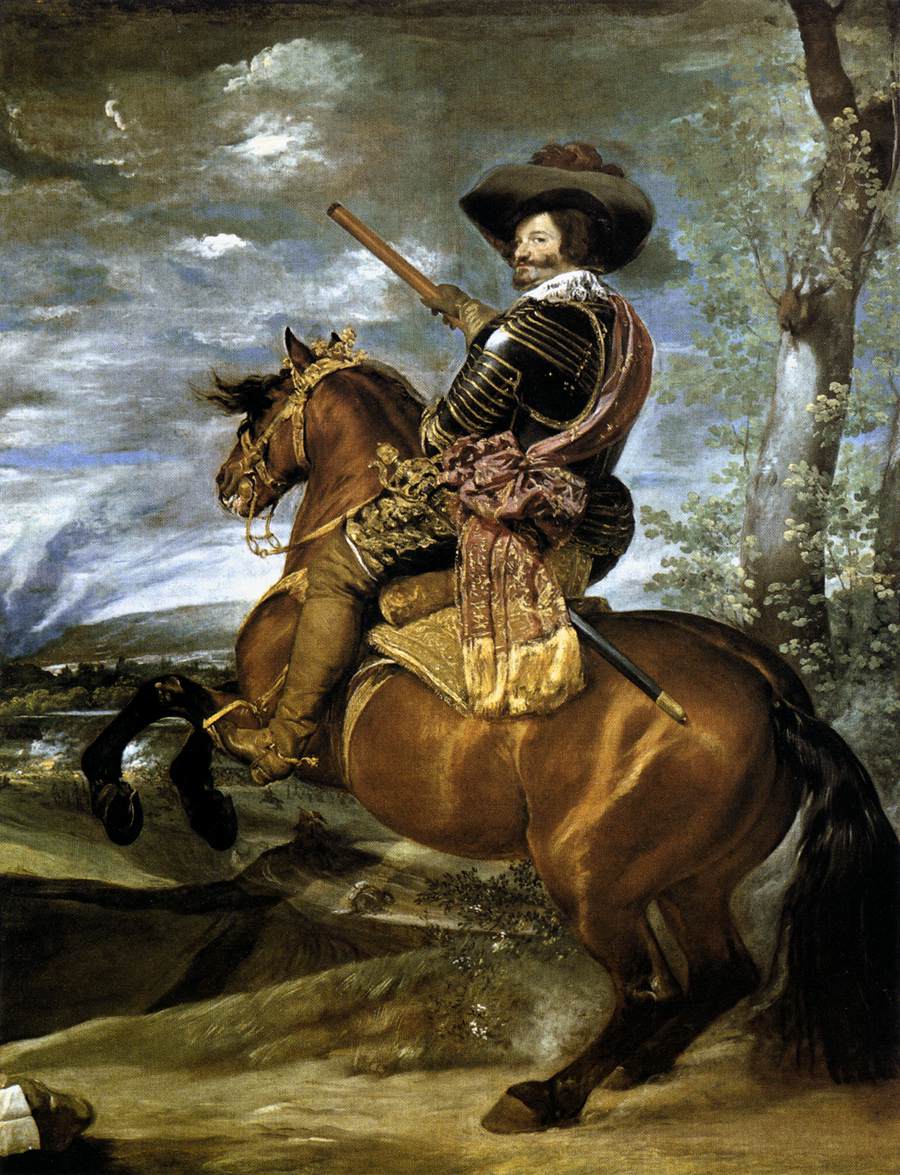
The Count-Duke of Olivares on Horseback
1634 · Museo del Prado, Madrid
portraitPhilip IV succeeded his father, Philip III of Spain, in 1621, and, for the first 22 years of his reign, Philip's valido, or chief minister, was the Conde-Duque de Olivares, who took the spread of the Thirty Years' War as an opportunity not only for resuming hostilities against the Dutch at the end of the Twelve Years' Truce of 1609 (1621) but also for an ambitious attempt to restore Spanish hegemony in Europe, in close alliance with the imperial branch of the Habsburg dynasty. Velázquez' most impressive equestrian portrait, painted in 1634, did not depict any member of the royal family but took as its subject Count-Duke of Olivares on Horseback. At that point in time, Olivares, by now the most powerful man in the kingdom, sometimes even more powerful than the king, could describe himself by the title of Count-Duke.
About the Artist
Diego Rodriguez de Silva y Velázquez
1599 – 1660
View all works →