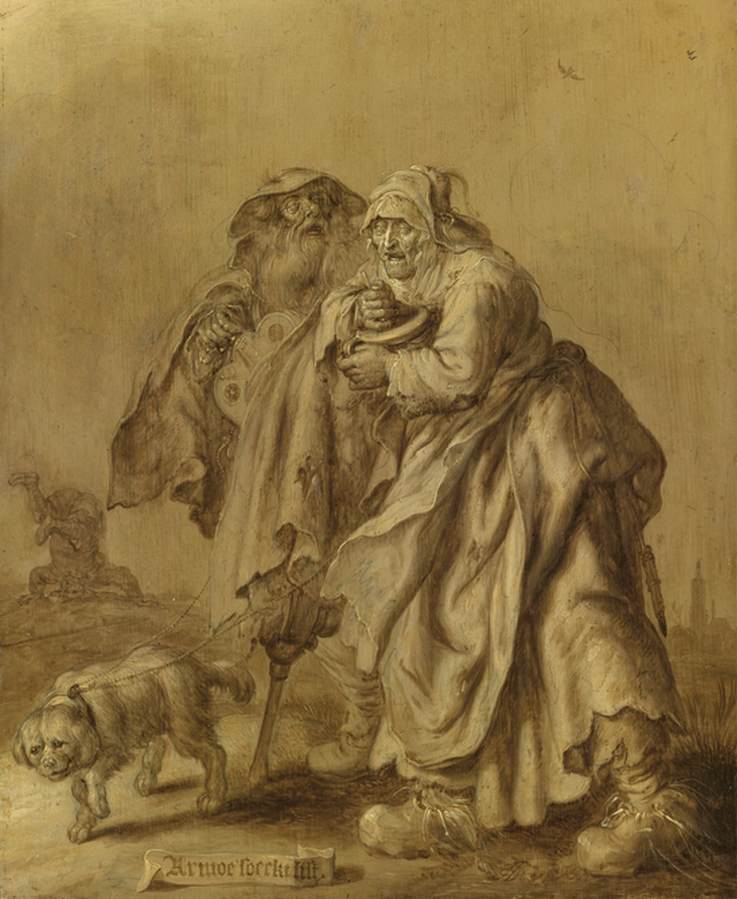
Adriaen Pietersz. van de Venne
1589 – 1662
Dutch painter, draughtsman and poet. De Bie's account (1661) is the only known source on van de Venne's youth and training. He was born of 'worthy' parents who had fled to Delft from the southern Netherlands to escape war and religious strife. Inspired by his early study of Latin to become an illustrator, he was partly self-taught but also received instruction in painting and illumination from the otherwise unrecorded Leiden goldsmith and painter Simon de Valck. His second teacher, Hieronymus van Diest (not the later marine artist), is equally obscure, but according to de Bie he painted grisailles, a technique that van de Venne later employed extensively. By 1614 he was in Middelburg, where his earliest dated paintings show the influence of the Flemish Jan Brueghel the Elder 's landscapes and of Jan's father Pieter Bruegel the Elder 's satirical, moralizing peasant vignettes. Van de Venne began working as a book illustrator, print designer, political propagandist, and poet, collaborating with his brother Jan, a well-known publisher and art dealer. Holland's leading writers employed Van de Venne, whose illustrations contributed greatly to the popularity of Dutch emblem books, which combined pictures and prose to present a moral lesson. After moving to The Hague and joining the Guild of Saint Luke in 1625, Van de Venne was probably employed at court. In 1640 he became the guild's dean. He continued his book and printmaking projects and painted most of his well-known grisaille paintings, many depicting the destitute and maimed. No significant artists followed his lead.
View all works →