Orazio Borgianni
1574 – 1616
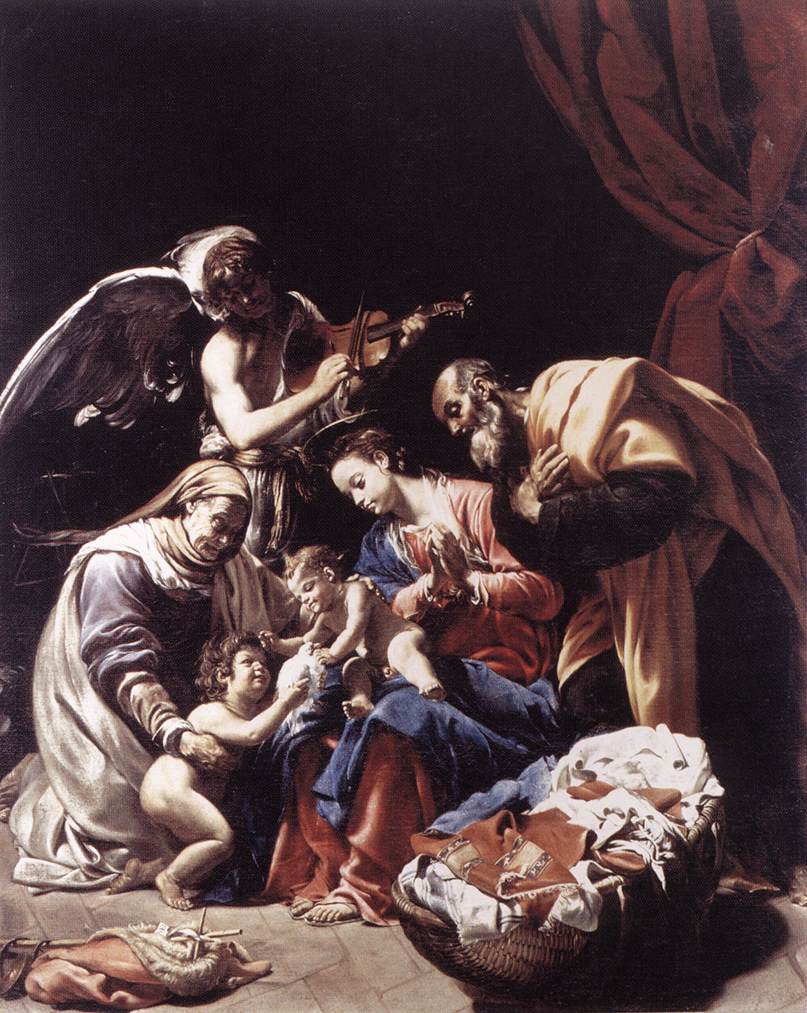
Recently discovered documents have shed new light on the career of Orazio Borgianni, who worked in Rome and Spain at the turn of the seventeenth century. He is recorded in Spain by 1598, although he might have arrived a year earlier, and continued to work there until c. 1605-06. Under the influence of works by El Greco and Jacopo Tintoretto, in Spain Borgianni executed The Crucifixion (Museo Provincial de Belles Artes, Cadiz) and The Stigmatisation of Sr Francis (Museo del Prado, Madrid). Once back in Rome, he increasingly responded to the work of Caravaggio, adopting an almost horrific realism and employing violent contrasts of light and shade, characteristics apparent in such paintings as the David Beheading Goliath (after 1607; Real Academia de San Fernando, Madrid). In 1608 Borgianni created one of the most deeply felt religious pictures of the time. The Virgin Appearing to St Francis (Sezze Romano, now partially destroyed), probably for San Francesco a Ripa, and in c. 1614, following a Caravaggesque penchant for still-life details, The Holy Family with the Infant St John the Baptist (Galleria Nazionale d'Arte Antica, Rome). A series of nine paintings for the high altar and the two lateral altars of the convent church of Porta Coeli, Valladolid, probably painted c. 1612 in Rome and sent to Spain, represents one of Borgianni's most important and extensive commissions. Among the painter's last works is a series of etchings after Raphael's Logge in the Vatican Palace, published in 1615. Besides religious subjects, Borgianni also painted several important portraits, including that of the poet Giovanni Battista Guarini (1605, lost), and the Portrait of an Architect (Alte Pinakothek, Munich).
View all works →