Andrea Vicentino
1542 – 1617
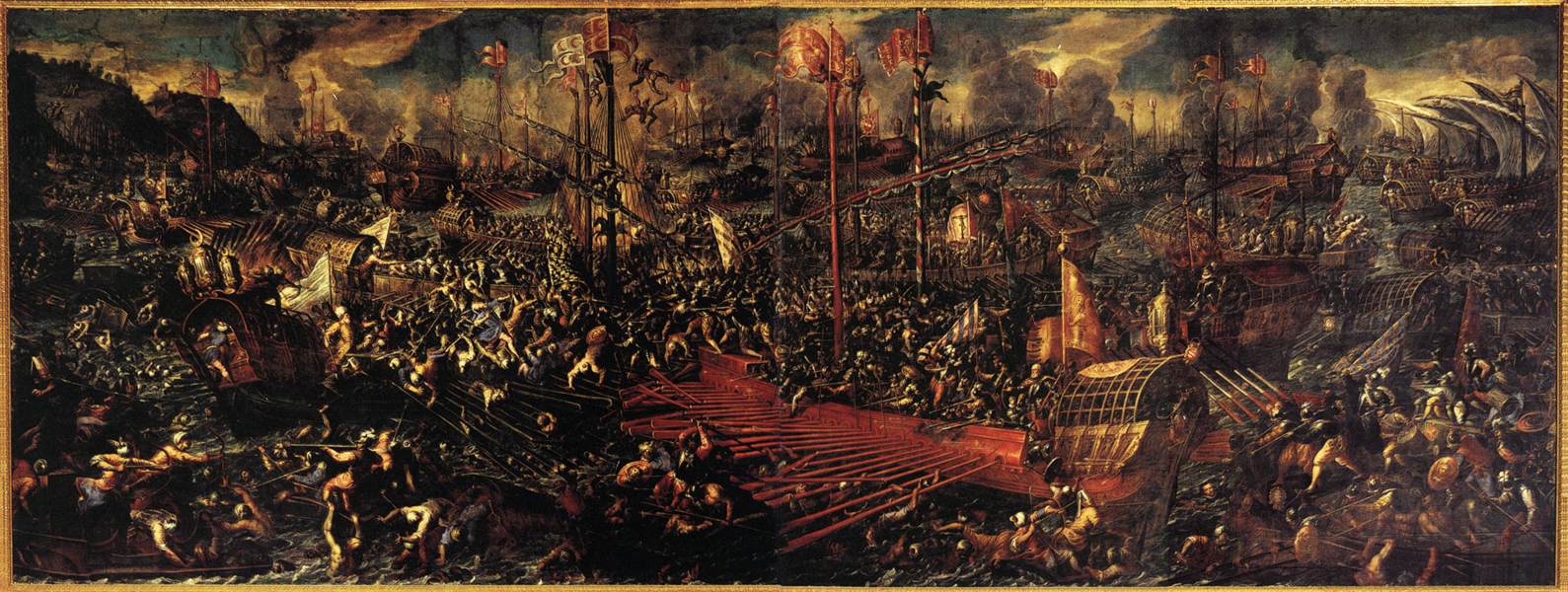
Andrea Vicentino (originally Andrea Michieli or Michelli), Italian painter. He probably trained in Vicenza with Giambattista Maganza (c. 1509-86). His mature style, however, was largely dependent on his subsequent experience of the dominant stylistic idioms at Venice in the later 16th century. Those of Paolo Veronese, Jacopo Tintoretto, Jacopo Bassano and Palma Giovane were particularly influential. He arrived in Venice in the mid-1570s and registered in the Venetian painters' guild in 1583. In this period he assisted Tintoretto at the Palazzo Ducale in Venice, making significant contributions to the ceiling decorations in the Sala del Senato and Sala dello Scrutinio. In the latter, he painted a replacement for Tintoretto's Battle of Lepanto (destroyed 1577), displaying considerable skill in his organization of a crowded composition through an all-dominant chiaroscuro. His style is closely dependent on Tintoretto, but his technique remains more literal, and his forms have a heavy, static quality closer to Veronese. Vicentino's proven ability as a history painter subsequently won him further important state commissions. Paintings such as the Arrival of Henry III at Venice (c. 1593; Venice, Palazzo Ducale, Sala delle Quattro Porte) had an important documentary value for Vicentino's patrons, as a kind of visual proof that the event actually had occurred. He was also active as a religious painter, both at Venice and on the mainland. Such altarpieces as the Madonna of the Rosary (1590s; Treviso Cathedral), God the Father with Three Theological Virtues (1598; Gambarare) and St Charles Borromeo (c. 1605; Mestre) confirm that he played an important role in the renovation of provincial altars in accordance with the requirements of the Counter-Reformation. His style in this context is more closely dependent on the visionary luminism of the late styles of Tintoretto and Jacopo Bassano.
View all works →