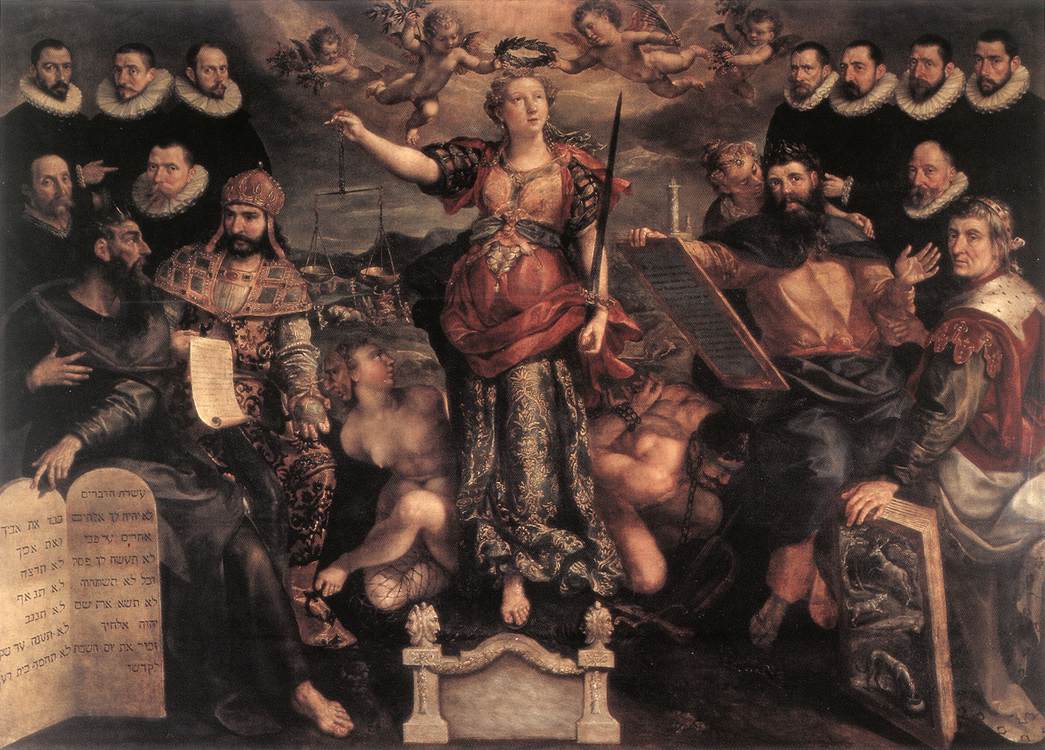
Marten de Vos
1532 – 1603
Flemish painter and draughtsman. In 1552 he went to Italy and studied in Rome, in Florence, and with Tintoretto in Venice. In 1558 he was back in Antwerp where after the death of Frans Floris in 1570 he became the leading Italianate artist in that city. The altarpieces that make up the bulk of his output are typically Mannerist in their strained, slender elegance. Together with the brothers Ambrosius Francken I and Frans Francken I, he ranks among the most important painters of altarpieces in Antwerp during the 1590s. Due, in part, to the Counter-Reformation, there was a renewed demand for altarpieces to replace those lost during iconoclastic riots in 1566 or the reformist movement of 1581. De Vos produced works for, among others, the Old Crossbowmen, the Brabant Coiners, the Antonites, the wine merchants and the Guild of St Luke. The importance of these works would seem to suggest that, after the deaths of Pieter Bruegel the Elder in 1569 and Frans Floris in 1570, de Vos was considered, with some justification, the most important figure painter in Antwerp before Rubens. Marten de Vos was also a prolific draughtsman, especially during the first half of the 1580s, when the Calvinists were in power in Antwerp. During this period he provided numerous designs for print publishers, such as Peeter Baltens, Frans van Beusecom, the widow of Hieronymus Cock, Adriaen Collaert, Phillip Galle, Willem van Haecht, Eduard van Hoeswinkel, Gerard de Jode, Hans van Luyck and Johannes Baptista Vrints. This increased activity is probably indicative of the economic recession and a dwindling market for paintings (especially of religious themes). A total of some 1600 prints were produced after designs by de Vos, an output three times that of Maerten van Heemskerck. De Vos's drawings have been praised for their lively, industrious and generally positive character, frequently with romantic Italianate landscapes in the background. His obvious proficiency is counterbalanced, however, by a degree of routine formularization.
View all works →