Henry Wallis
1830 – 1916
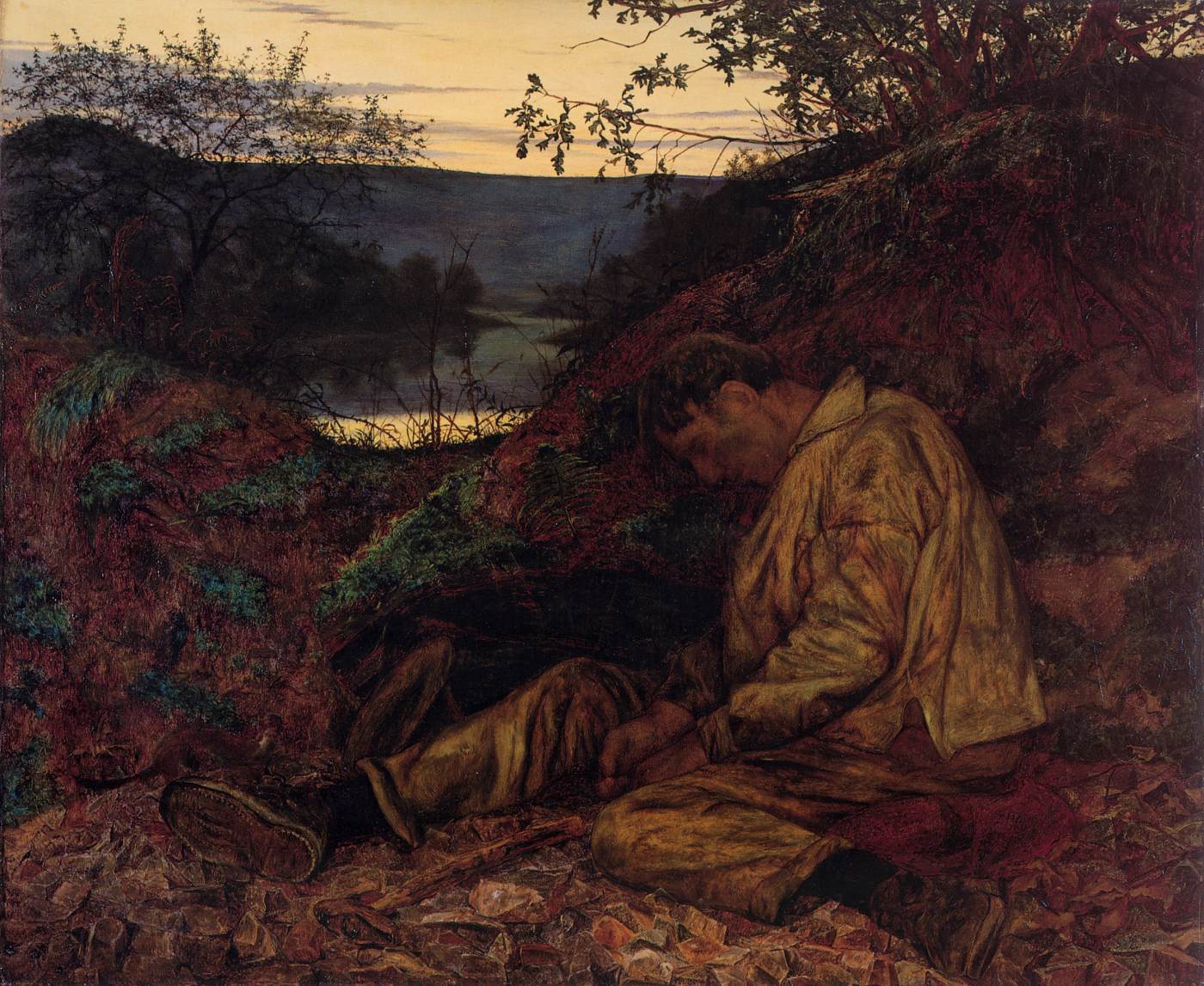
English painter, writer and collector. He entered the Royal Academy Schools in London in 1848. He is also thought to have trained in Paris at some time in the late 1840s or early 1850s. He specialized in portraits of literary figures and scenes from the lives of past writers. His first great success was the Death of Chatterton (Tate Britain, London) which he exhibited at the Royal Academy in 1856. The painting was universally praised, not least by John Ruskin, who described it as 'faultless and wonderful', advising visitors to 'examine it well, inch by inch'. The success of Chatterton was such that, when exhibited in Manchester the following year, it was protected from the jostling crowds by a policeman. It was bought by another artist, Augustus Egg. Wallis's next success came in 1858 with the exhibition at the Royal Academy of The Stonebreaker (Museum and Art Gallery, Birmingham). Accompanied by quotations from Tennyson's poem 'A Dirge' (1830) and Thomas Carlyle's Sartor Resartus (1833-34), its theme was the human cost of hard labour and poverty. It showed a dead stone-breaker slumped by the roadside in a symbolically twilit landscape. In the early 1860s, Wallis was an exhibitor, along with various Pre-Raphaelites at the Hogarth Club, London. He also continued to show history paintings, many with a literary theme, at the Royal Academy until 1877. He was also a prolific watercolourist, exhibiting over 80 examples at the Old Water-Colour Society, to which he was elected in 1880. He travelled widely in Europe and the Near East; many of his later paintings show scenes or events witnessed during his travels. In late life, he made less impact as a painter than he did as an authority on Italian and oriental ceramics, about which, during the last two decades of his life, he wrote several books and articles, many of them illustrated by his own drawings. He also built up a huge collection of ceramics, which is now in the Victoria and Albert Museum. In the 1890s, he was also involved in campaigns to preserve ancient Egyptian monuments.
View all works →