Goffredo Wals
1600 – 1639
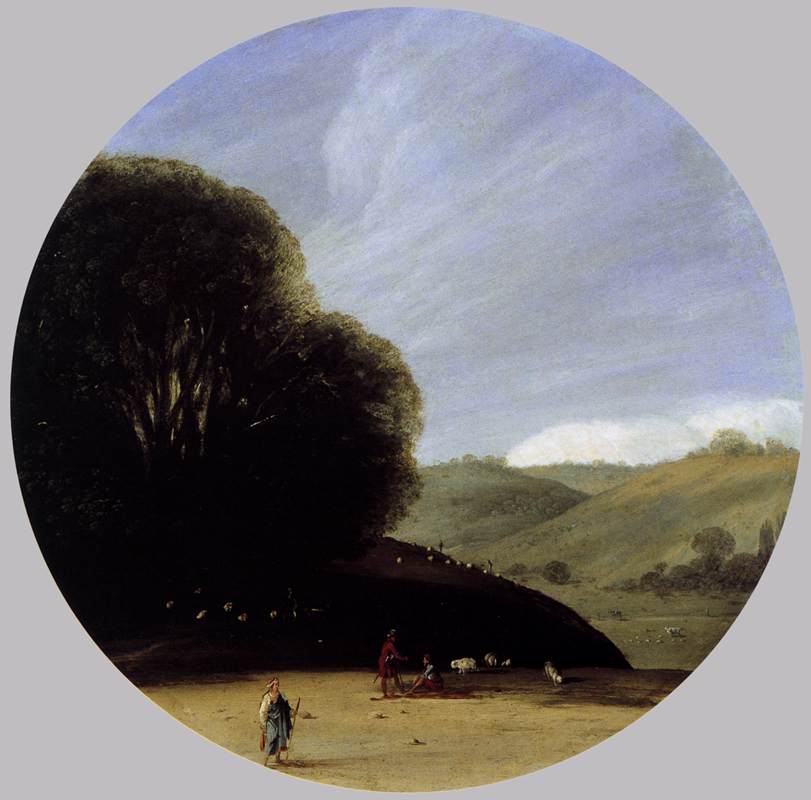
German painter, draughtsman and printmaker, active in Italy. According to early sources, Wals left Cologne at the tender age of fourteen and ventured to Italy. In Naples he found work colouring engravings, while from 1616 or 1617 until the end of November 1618, he worked in the Roman studio of Agostino Tassi. Further information about his career is scarce. However, Filippo Baldinucci tells how Wals's fame as a painter of landscapes and perspectives encouraged Claude Lorrain to study with him in Naples, probably from 1620-22. Claude's time with Wals was instrumental in his development of the idealised Italianate landscape. Around 1630 Wals was in Genoa, where he lived with Bernardo Strozzi and taught Antonio Travi. He briefly visited Savona from 1631-32 before returning again to Naples. The Italian landscapes with careful light effects which Wals painted in small, often circular, format were derived from Adam Elsheimer, but given practical shape by Tassi, who is thought to have inspired, for instance, their simple stratification across three planes. Wals's art is also often mentioned in connection with that of Filippo Napoletano, although the precise relationship of their work is unclear, essentially because none of Wals's paintings are signed or dated. The same problem clouds his relationship during the 1620s and 1630s with the Dutch followers of Paul Bril, Bartholomeus Breenbergh and Cornelis van Poelenburch. Wals's most important patron was a Flemish merchant in Naples, Caspar Roomer, who according to an inventory of 1634 owned 60 of his oil paintings and fourteen gouaches. Wals's gem-like works were also highly sought after by noble households to decorate their cabinets. His pastoral landscapes provided the stepping stone between the humble nature painted by Elsheimer and the arcadian vision of Claude. Sometime between 1638 and 1640 Wals perished in an earthquake in Calabria.
View all works →