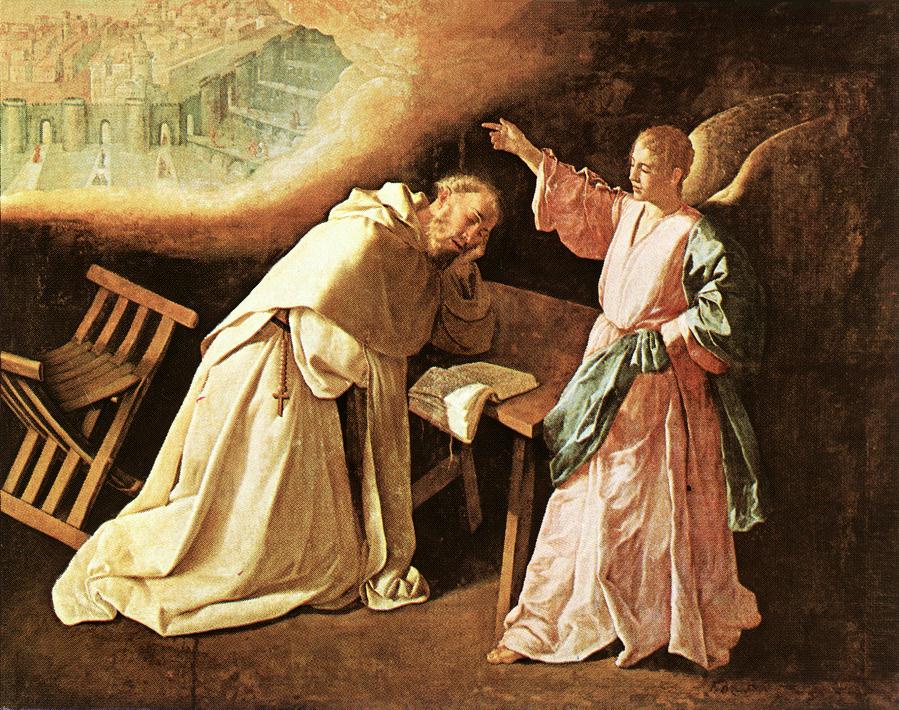
Francisco de Zurbarán
1598 – 1664
Spanish painter of saints and churchmen. His use of sharply defined, often brilliant, colors, minute detail in simple compositions, strongly three-dimensional modeling of figures, and the shadowed light that brightly illuminates his subjects all give his paintings a solidity and dignity evocative of the solitude and solemnity of monastic life. His work at its best fuses two dominant tendencies in Spanish art, realism and mysticism. Zurbarán was born of Basque ancestry in Fuente de Cantos, Badajoz Province, on November 7, 1598. He was apprenticed to a minor Spanish painter in Seville but appears to have been influenced early in his career by Michelangelo. In 1617 he went to work in Llerena, and in 1629, at the invitation of the town council, he settled in Seville. Zurbarán spent the next 30 years there, with the exception of two years (1634-35) that he spent in Madrid working for the royal court. Zurbarán left Seville in 1658, after his reputation declined there; he died in Madrid on August 27, 1664. Zurbarán was only slightly influenced by Diego Rodriguez Velázquez and Jusepe de Ribera. Late in his career, however, he changed his style, according to some critics, for the worse, after being influenced by Bartolomé Estéban Murillo. Zurbarán's earliest known work, painted when he was 18 years old, is Immaculate Conception (private collection, Bilbao). Other notable early works include Crucifixion (1627-29, Museum of Fine Arts, Seville); several large scenes of the life of St Peter Nolasco (died 1256), the founder of the Mercedarians, originally done for a convent in Seville (1628-29); The Apotheosis of St. Thomas Aquinas (1631, Museum of Fine Arts, Seville); and Still Life with Oranges (1633, Norton Simon Museum, Pasadena).
View all works →