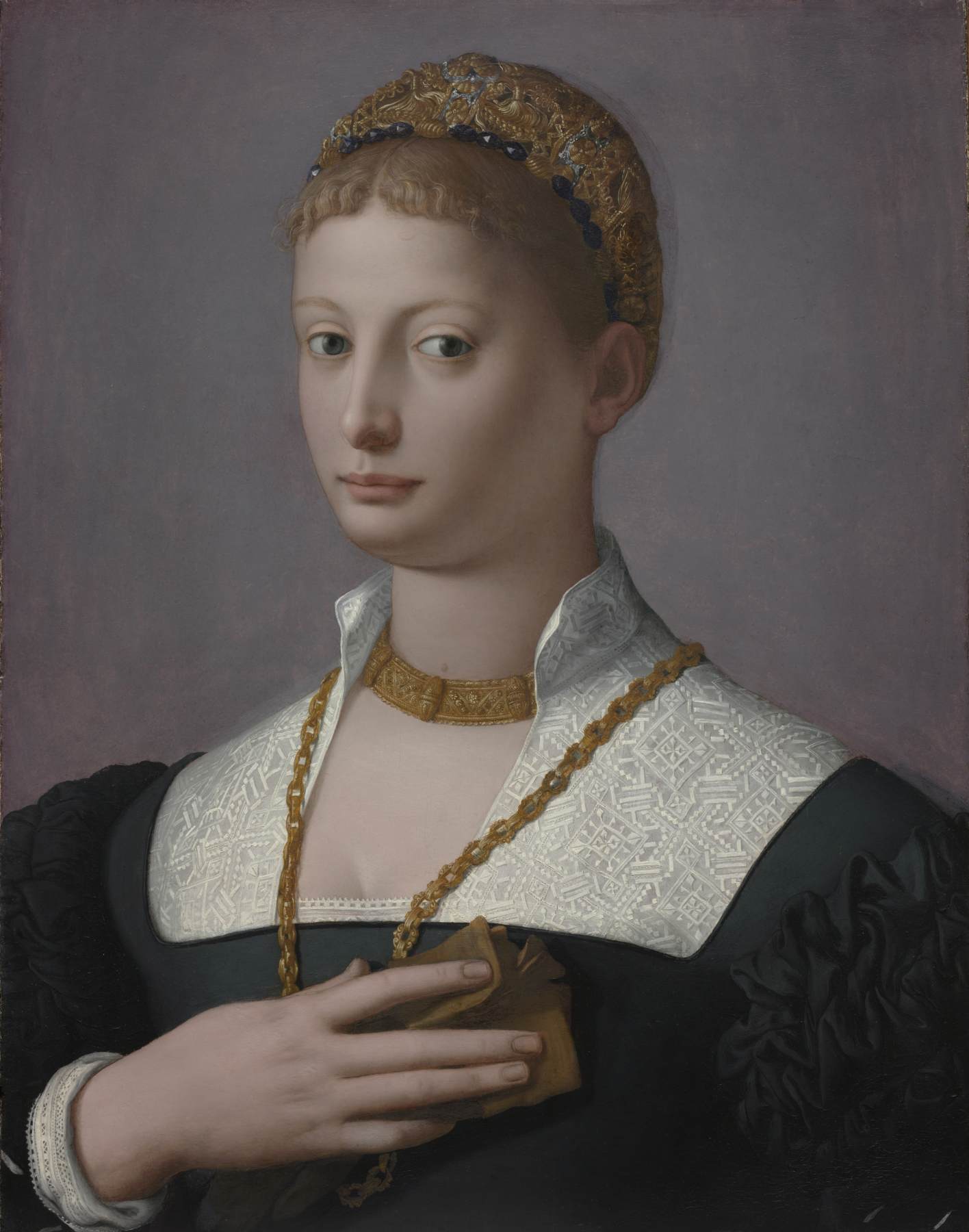
Agnolo Bronzino
1503 – 1572
Florentine Mannerist painter (originally Agnolo di Cosimo), the pupil and adopted son of Pontormo, who introduced his portrait as a child into his painting Joseph in Egypt (National Gallery, London). The origin of his nickname is uncertain, but possibly derived from his having a dark complexion. Bronzino was deeply attached to Pontormo and his style was heavily indebted to his master. However, Bronzino lacked the emotional intensity that was such a characteristic of Pontormo's work and excelled as a portraitist rather than a religious painter. He was court painter to Duke Cosimo I de Medici for most of his career, and his work influenced the course of European court portraiture for a century. Cold, cultured, and unemotionally analytical, his portraits convey a sense of almost insolent assurance. Bronzino was also a poet, and his most personal portraits are perhaps those of other literary figures ( Laura Battiferri, Palazzo Vecchio, Florence, c.1560). He was less successful as a religious painter, his lack of real feeling leading to empty, elegant posturing, as in The Martyrdom of S. Lorenzo (S. Lorenzo, Florence, 1569), in which almost every one of the extraordinarily contorted poses can be traced back to Raphael or to Michelangelo, whom Bronzino idolized. It is the type of work that got Mannerism a bad name. Bronzino's skill with the nude was better deployed in the celebrated Venus, Cupid, Folly, and Time (National Gallery, London), which conveys strong feelings or eroticism under the pretext of a moralizing allegory. His other major works include the design of a series of tapestries on The Story of Joseph for the Palazzo Vecchio. He was a much respected figure who took a prominent part in the activities of the Accademia del Disegno, of which he was a founder member in 1563. His pupils included Alessandro Allori, who - in a curious mirroring of his own early career - was also his adopted son.
View all works →