Ippolito Caffi
1809 – 1866
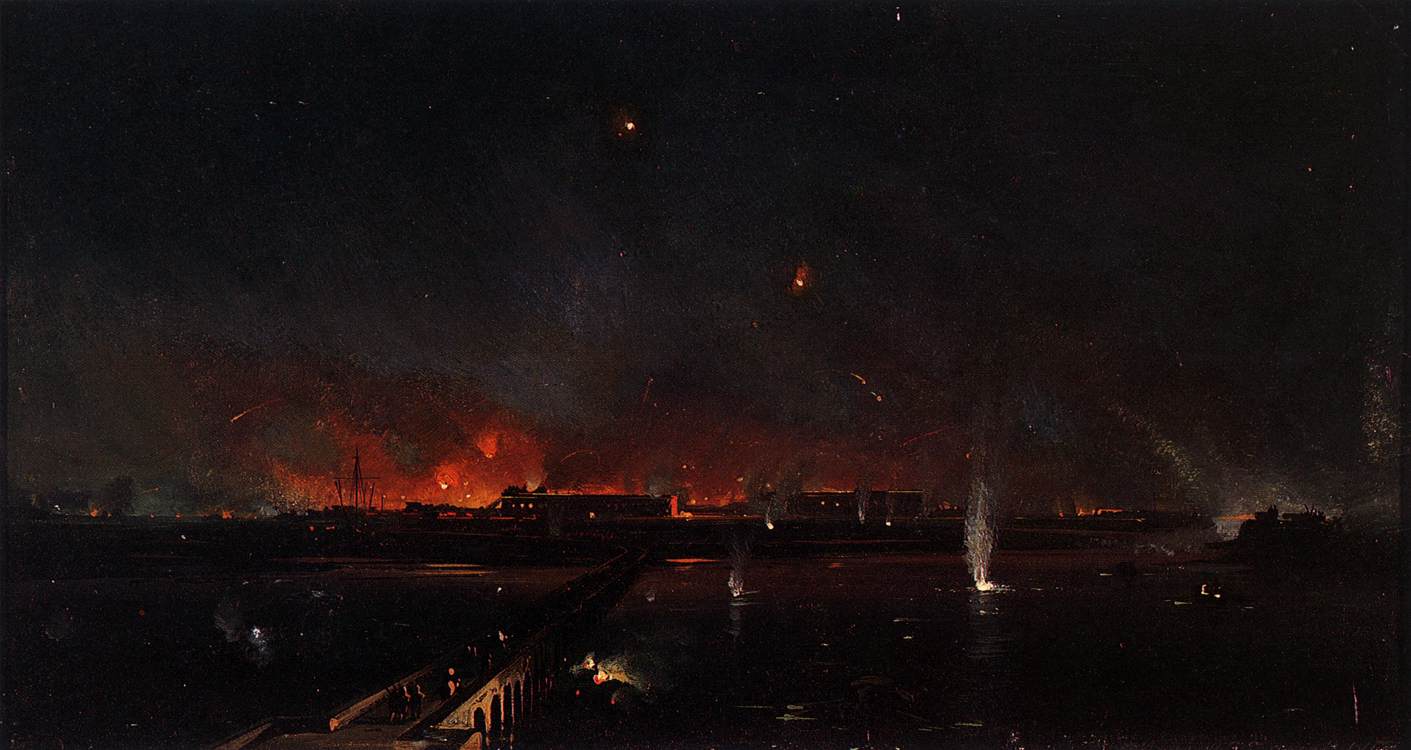
Italian painter. After training initially in Belluno (1821-25), then in Padua with his cousin Pietro Paoletti (1801-47), Caffi attended the Accademia di Belle Arti in Venice (1827-31), studying under Teodoro Matteini (1754-1831), Francesco Bagnara (1784-1866) and Tranquillo Orsi (1771-1845). In 1832 he moved to Rome, acquiring immediate fame as a vedutista. He displayed a virtuoso command of spatial construction; in 1835 he published a textbook on perspective, Lezioni di prospettiva pratica, with Antonio Bianchini. Caffi modernized the veduta vocabulary inherited from Canaletto, selecting new points of view, and he showed an interest in nocturnal scenes with artificial or lunar illumination, in recording the effects of light and atmosphere at particular times, and in chronicling unusual events such as eclipses and balloon flights. He is a highly fascinating artist and romantic figure, among the greatest and most original vedutisti of 19th-century Italy. During his short yet intense lifetime he achieved great fame and admiration, his landscapes and other works of art taking on a European dimension and breadth that make him similar to Corot. Yet in addition to being one of the most acclaimed artists of his time, Caffi was also a bold, restless person, an adventurous soul, an untiring traveler and a devoted patriot with his involvement in the movements of 1848-49, Austrian persecution and the Third War of Independence until his premature death at only age 57 during the battle of Lissa aboard the flagship Re d'Italia. His most famous work, the Last Hour of Carnevale in Rome (The Candles) (1837; Venice, Ca' Pesaro), displays the originality of his style. Rome appears as an illusionistically vast stage on which human figures are simply sparks of light and patches of vivid colour. Exhibited in Venice, it met with enormous success; Caffi executed 42 replicas, a practice he adopted for other popular subjects. Veiled light and heavy atmosphere are the main elements of Venice in the Snow (1850; Trieste, Museo Civico Revoltella).
View all works →