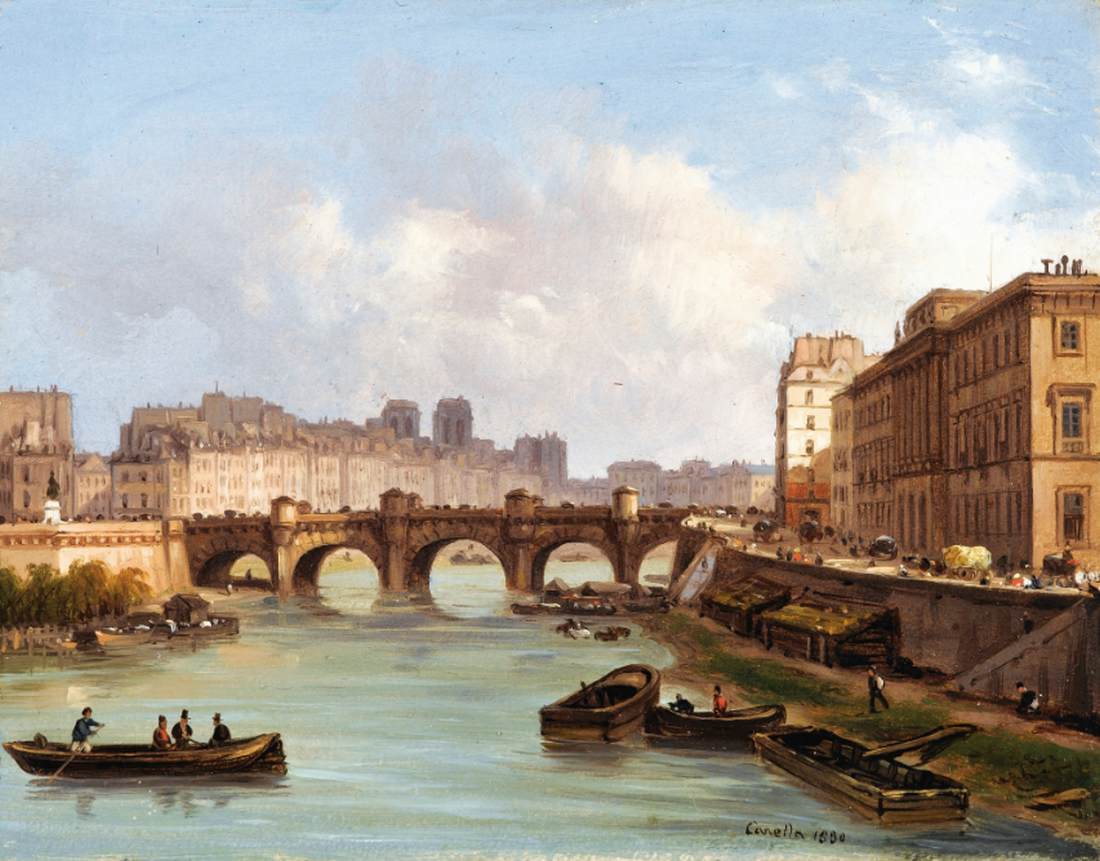
Giuseppe Canella
1788 – 1847
Italian painter, part of a family of artists. The head of the family, Giovanni Canella (1750-1847) was a fairly important architect who worked in a Classical style. He enrolled his two sons in the Accademia di Belle Arti di Venezia to study the style of painting that was most fashionable at the time. For his younger son, Carlo Canella (1800-1880), the time spent in Venice was short and from there he was off to study with Giovanni Migliara at the Accademia di Brera in Milan. For Giuseppe, on the other hand, the years spent in Venice became a way to compare his work to that of Venetian masters from the 1700s. He chose to insert himself into an imaginary line that started with Guardi and continued on to Bison and Tranquillo Orsi. His landscapes tend to be a lyrical note jotted from reality in opposition to the exact reproductions inspired by Canaletto 's work as interpreted by Vincenzo Chilone and his school, the most famous in Venice in the early 1800's. Canella's work was mostly bought by foreigners. By 1833 the artist had already lived in Madrid and Paris, where he was honoured by receiving a gold medal from Louis Phillippe, a great admirer and a collector of his work. From Paris he went to Fontainebleau, not far from Barbizon where, in 1830, a group of painters known as the Barbizon School began to produce works that renewed landscape painting in France and in all of Europe. At the 1824 Salon he saw and was strongly influenced by masterpieces by John Constable. Three years later he was again strongly influenced, this time by Corot's painting The Bridge at Narni today in the Louvre. By the time he came back to Italy in 1832 he was an avant-garde artist both in Milan and in Florence.
View all works →