Domenico Maria Canuti
1625 – 1684
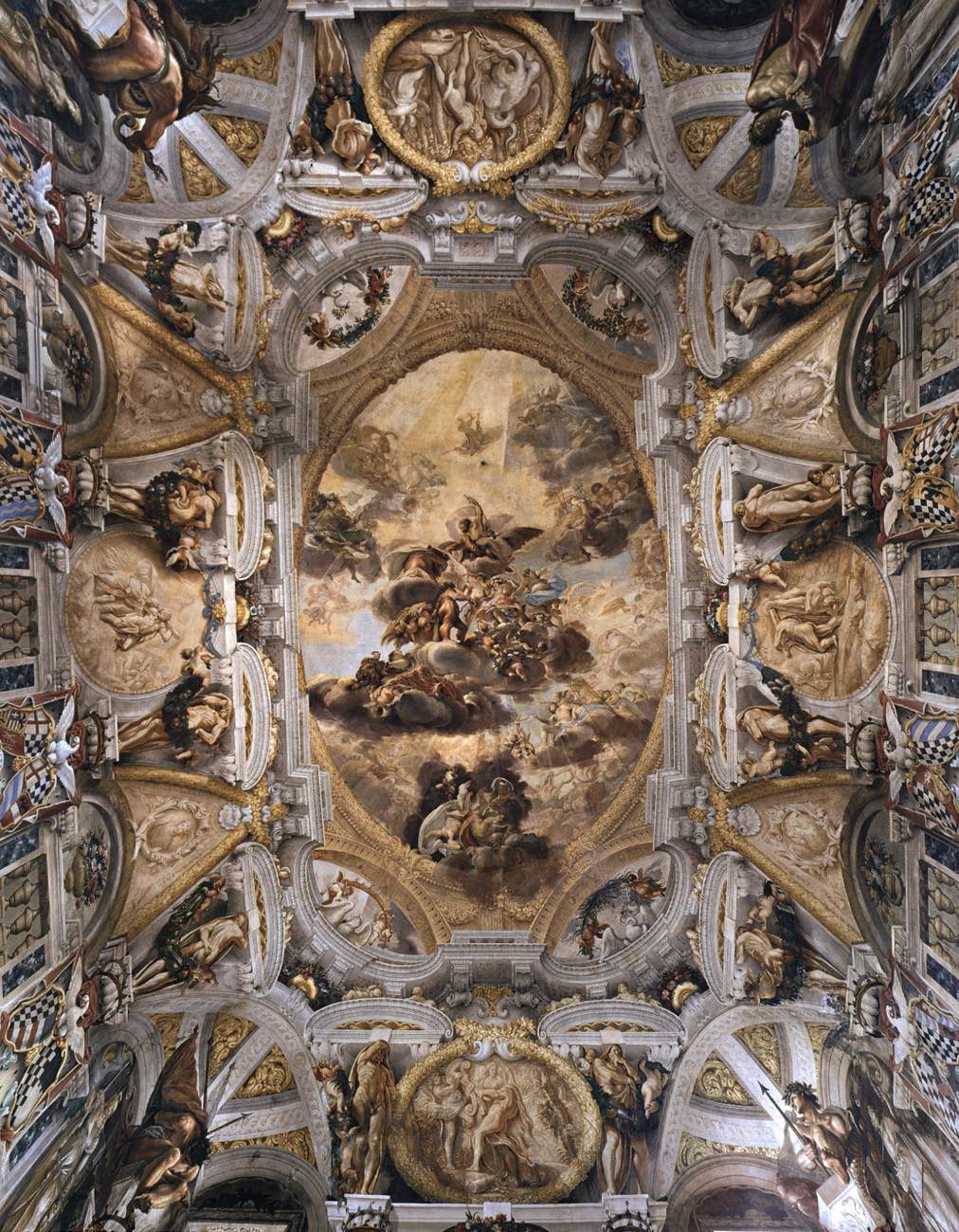
Italian painter. After training in Bologna under Guido Reni, Guercino, Giovanni Andrea Sirani and Francesco Gessi (1588-1649), he was in Rome from 1651 to 1655 under the patronage of Abbot Taddeo Pepoli, a distinguished Bolognese scholar. His Bolognese origins, specifically a debt to Reni and the Carracci, are apparent in the Ecstasy of St Cecilia (Imola, Santa Maria di Valverde), considered to be his first work. The Universal Judgment (Bologna, San Girolamo della Certosa), signed and dated 1658, shows the development of a more Baroque style. That he was also aware of Venetian painting is apparent in his first ceiling fresco, the Triumph of Bacchus and Ariadne (c. 1664; Bologna, Palazzo Fibbia, now Masetti-Calzolari), executed in collaboration with the quadraturista Domenico Santi, called Mengazzino (1621-1694). Here Canuti tried to conceal any distinction between the real space of the hall and his illusionistic spatial cone traversed by bands of radiating light. From 1650 to 1660 and later in the 1670s, he was employed in Rome where he painted the quadratura decoration of the ceiling of church of Santi Domenico e Sisto with the Apotheosis of Saint Dominic. He was often patronized by the Olivetans. He was employed with Francesco Cozza (1605-1682) and Carlo Maratti in the decoration of Palazzo Altieri. He also did frescoes in Palazzo Colonna. Returning to Bologna (c. 1657), he completed frescoes in the library of San Michele in Bosco and the Palazzo Pepoli Campogrande, and in the ducal palace at Mantua. He helped fresco the Palazzo Felicini in Bologna with Domenico Santi and Giacomo Alboresi (1632-1677). Canuti was also active as an engraver. Among his works are portraits of Ludovico, Agostino, and Annibale Carracci, The Virgin in the Clouds with Christ, and St Francis Praying after Guido Reni. From a young age, the painter enjoyed the protection of the Pepoli family. His light colours, his energetic approach, and his figural repertoire were clearly influenced by the Roman baroque, especially Lanfranco and Pietro da Cortona. Although he is now little known beyond the confines of his hometown, in the seventeenth and eighteenth centuries he was thought to be equal of his teacher Guido Reni.
View all works →