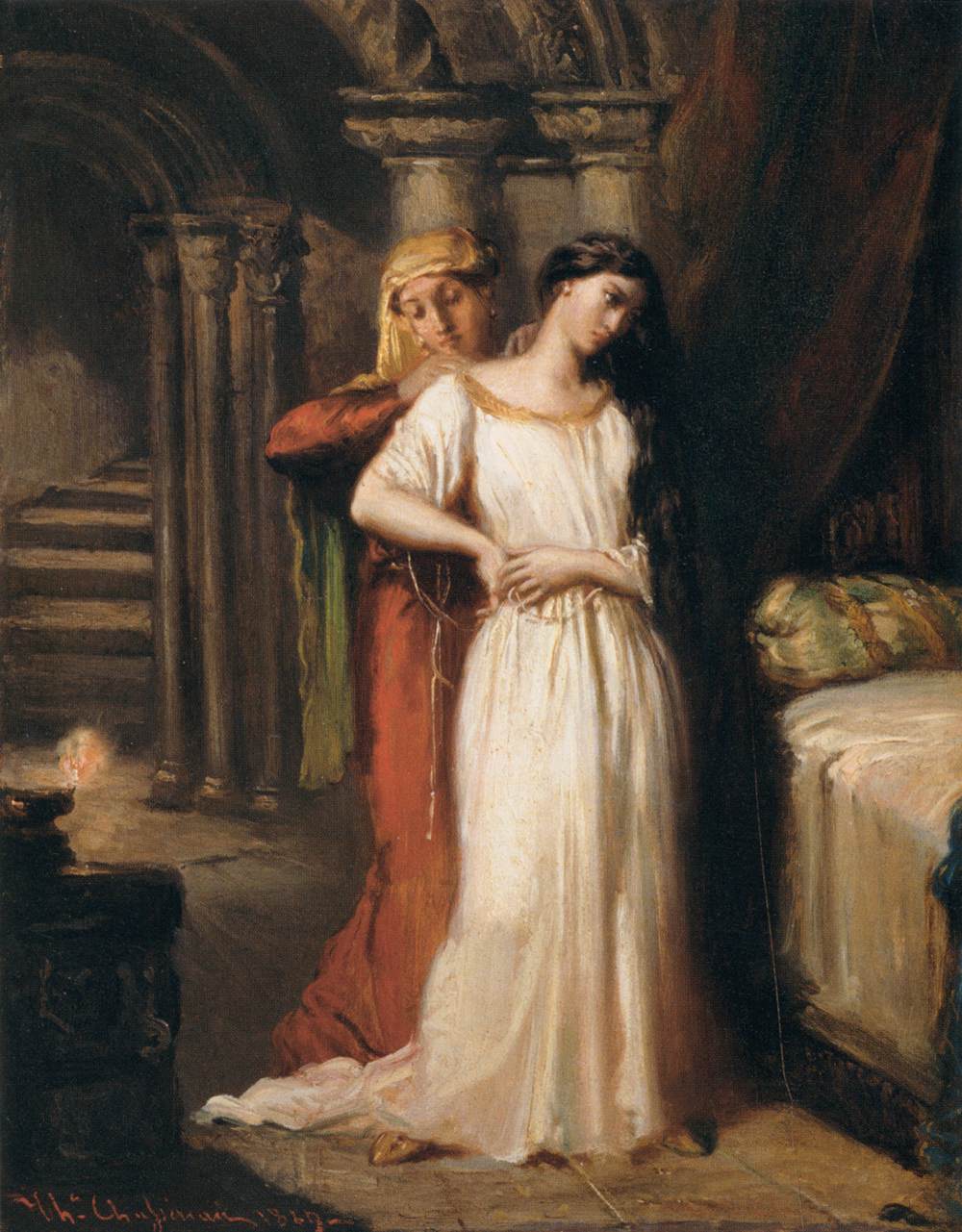
Théodore Chassériau
1819 – 1856
French painter and printmaker. In 1822 Chassériau moved with his family to Paris, where he received a bourgeois upbringing under the supervision of an older brother. A precociously gifted draughtsman, he entered Ingres 's studio at the age of 11 and remained there until Ingres left to head the Académie de France in Rome in 1834. He made his Salon début in 1836 with several portraits and religious subjects, including Cain Accursed (Paris, private collection), for which he received a third-class medal. Among his many submissions in subsequent years were Susanna Bathing (1839, exhibited Salon 1839; Paris, Louvre), a Marine Venus (1838; exhibited Salon 1839; Paris, Louvre) and the Toilet of Esther (1841, exhibited Salon 1842; Paris, Louvre); these three paintings of nude female figures combine an idealization derived from Ingres with a sensuality characteristic of Chassériau. In the 1840s he conceived an admiration for Delacroix and attempted, with considerable success, to combine Ingres's classical linear grace with Delacroix's Romantic colour. His chief work was the decoration of the Cour des Comptes in the Palais d'Orsay, Paris, with allegorical scenes of Peace and War (1844-48), but these were almost completely destroyed by fire. There are other examples of his decorative work, however, in various churches in Paris. Chassériau was also an outstanding portraitist and painted nudes and North African scenes (he made a visit there in 1846).
View all works →