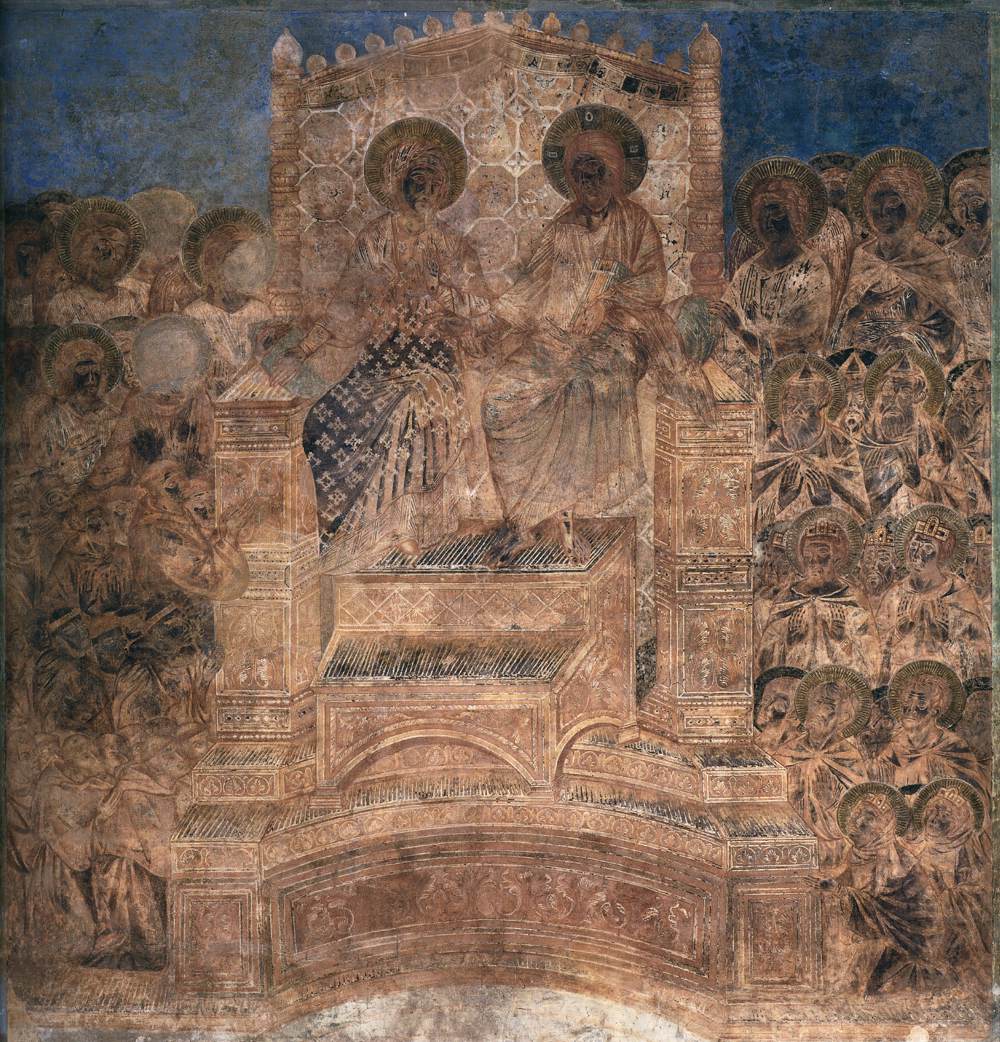
Cimabue
1240 – 1302
Florentine painter. His nickname means 'Ox-head'. He was a contemporary of Dante, who refers to him in The Divine Comedy (Purg. xi. 94-6) as an artist who was 'believed to hold the field in painting' only to be eclipsed by Giotto's fame. Ironically enough this passage, meant to illustrate the vanity of short-lived earthly glory, has become the basis for Cimabue's fame; for, embroidering on this reference, later writers made him into the discoverer and teacher of Giotto and regarded him as the first in the long line of great Italian painters. He was said to have worked in the 'Greek' (i.e. Byzantine) manner, but to have begun the movement towards greater realism which culminated in the Renaissance. Documentary evidence is insufficient to confirm or deny this estimate of Cimabue's art. The only work that can be proved to be by his hand is a St John forming part of a larger mosaic in Pisa Cathedral (1302), but tradition has tended to attribute to Cimabue many works of outstanding quality from the end of the 13th century, such as the Madonna of Santa Trinità (Uffizi, Florence), a cycle of frescos in the Upper Church of San Francesco in Assisi, and a majestic Crucifix in Santa Croce (badly damaged in the Florence flood of 1966). If these highly plausible attributions are correct, Cimabue was indeed the outstanding master of the generation before Giotto. The movement towards greater naturalism, however, may owe more to contemporary Roman painters and mosaicists ( Cavallini, Torriti) than to him; he is documented in Rome in 1272 and could have known their work.
View all works →