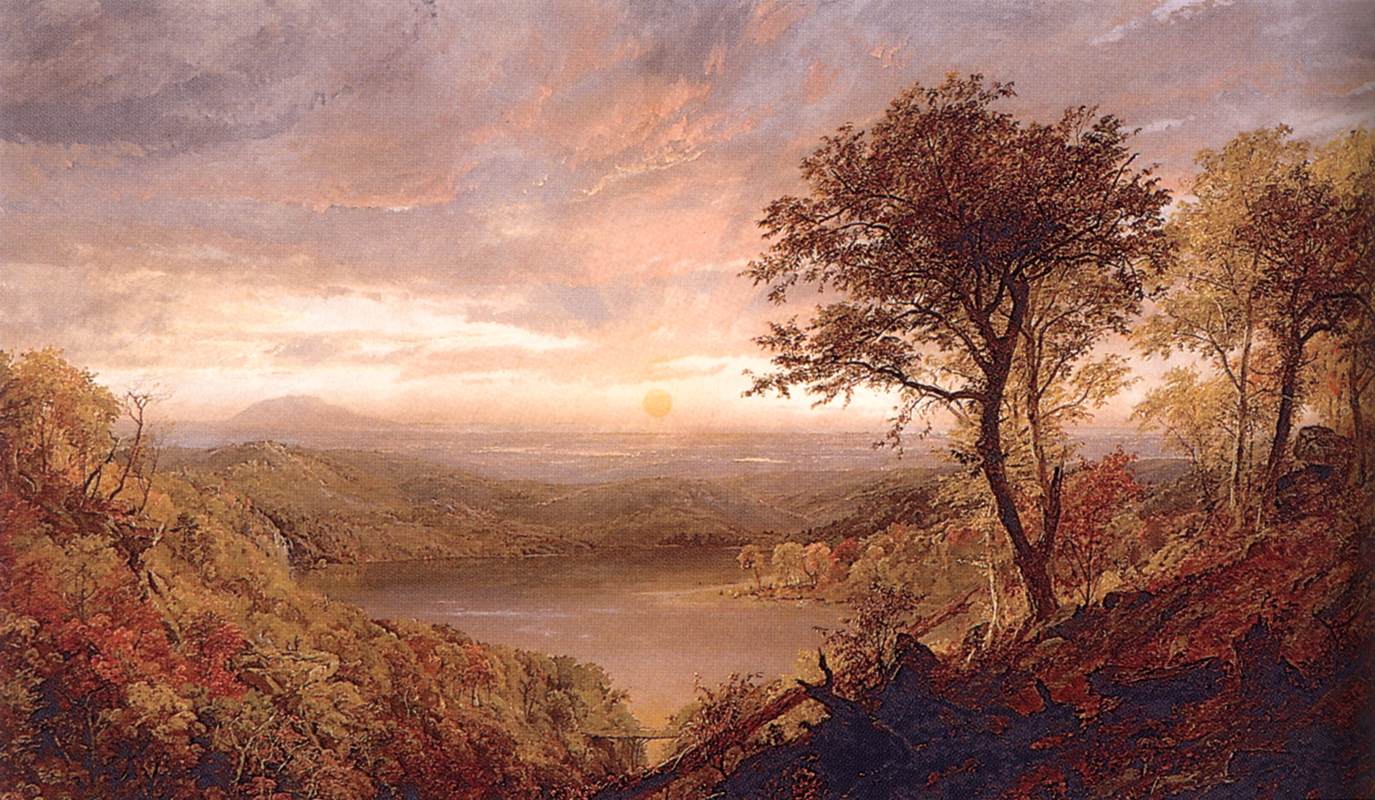
Jasper Francis Cropsey
1823 – 1900
American painter and architect. He was a practicing architect by 1843, but in that year he also exhibited a landscape painting, to favourable reviews, at the National Academy of Design, in New York. He greatly admired Thomas Cole for his dramatic use of the American landscape, but Cropsey brought to his panoramic vistas a more precise recording of nature. In 1847 Cropsey made his first trip to Europe, settling in Rome among a circle of American and European painters. His eye for detail in recording nature was encouraged by the Nazarenes, and his American sympathy for historical and literary subjects was sharpened by the antiquities of Italy. He also visited England, France, Switzerland in 1847. He went abroad again in 1855, and resided seven years in London, sending his pictures to the Royal Academy and to the International exhibition of 1862. After his return home in 1863, he opened a studio in New York, where he resided until 1885, when he removed to Hastings-on-Hudson. He co-founded, with ten fellow artists, the American Society of Painters in Water Colours in 1866. Cropsey's interest in architecture continued throughout his life and was a strong influence in his painting, most evident in his precise arrangement and outline of forms. But Cropsey was best known for his lavish use of colour and, as a first-generation member from the Hudson River School, painted autumn landscapes that startled viewers with their boldness and brilliance.
View all works →