Paolo Anesi
1697 – 1773
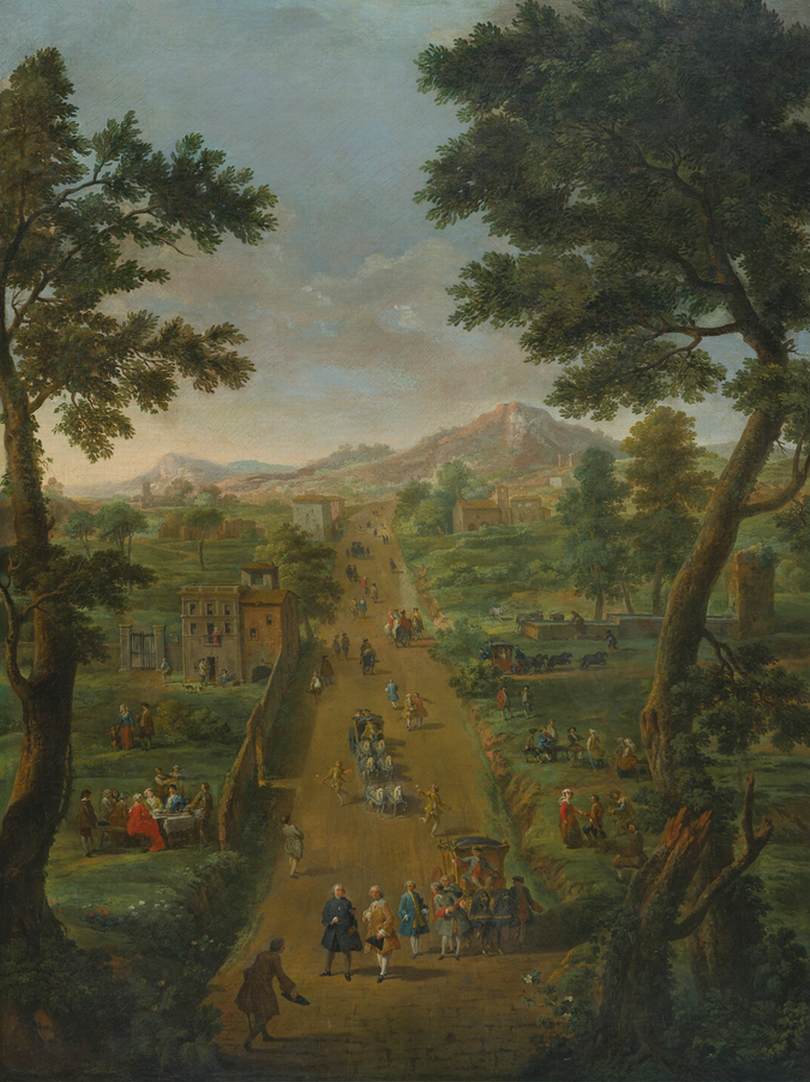
Italian painter, draughtsman and engraver. He was the son of Pietro Anesi, a silk weaver from Venice. Paolo studied figure painting with Giuseppe Chiari and, in 1715, landscape painting with Bernardino Fergioni (1674-?1738), who was also teaching Andrea Locatelli at that time. Sebastiano Conca was another of Anesi's teachers. In 1723 Anesi married the daughter of the architect Giuseppe Sardi. His earliest known work is a drawing (1719; Florence, Uffizi), but he made his reputation with the only known example of his engraved work: Varie vedute inventate ed intagliate, dedicated to Cardinal Giuseppe Renato Imperiali and published in Rome in 1725. Anesi was one of the most important landscapist working in Rome in the mid-18th century and he specialised in painting views and ideal landscapes inspired by the Roman campagna. His style is reminiscent of Andrea Locatelli whose works have often been confused with Anesi's. His documented frescoes painted for Cardinal Alessandro Albani in Villa Albani (now Torlonia) in 1761 and the large cycle of canvases he painted in 1767 for Villa Chigi at Monte delle Gioie are amongst Anesi's most accomplished works. Anesi's frescoes in Villa Chigi (now Torlonia), commissioned by Cardinal Alessandro Albani (1692-1779), are documented from 1761. The project for the villa originated in 1745 and construction began in 1751, reaching completion twelve years later. Villa Albani was built primarily to house Cardinal Alessandro's extensive collection of antiquities and ancient Roman sculpture, much of which was dispersed after the Napoleonic wars. Anesi's numerous vedutas were bought by foreigners, mostly British, who loved this genre in the style of Canaletto and Zuccarelli. His landscape paintings are present in the Galleria Doria Pamphili, Galleria Corsini and Galleria Pallavicini in Rome, while a series of four Roman landscapes are in the collection of the Diocesan Museum of Milan.
View all works →