Jacques Daret
1404 – 1470
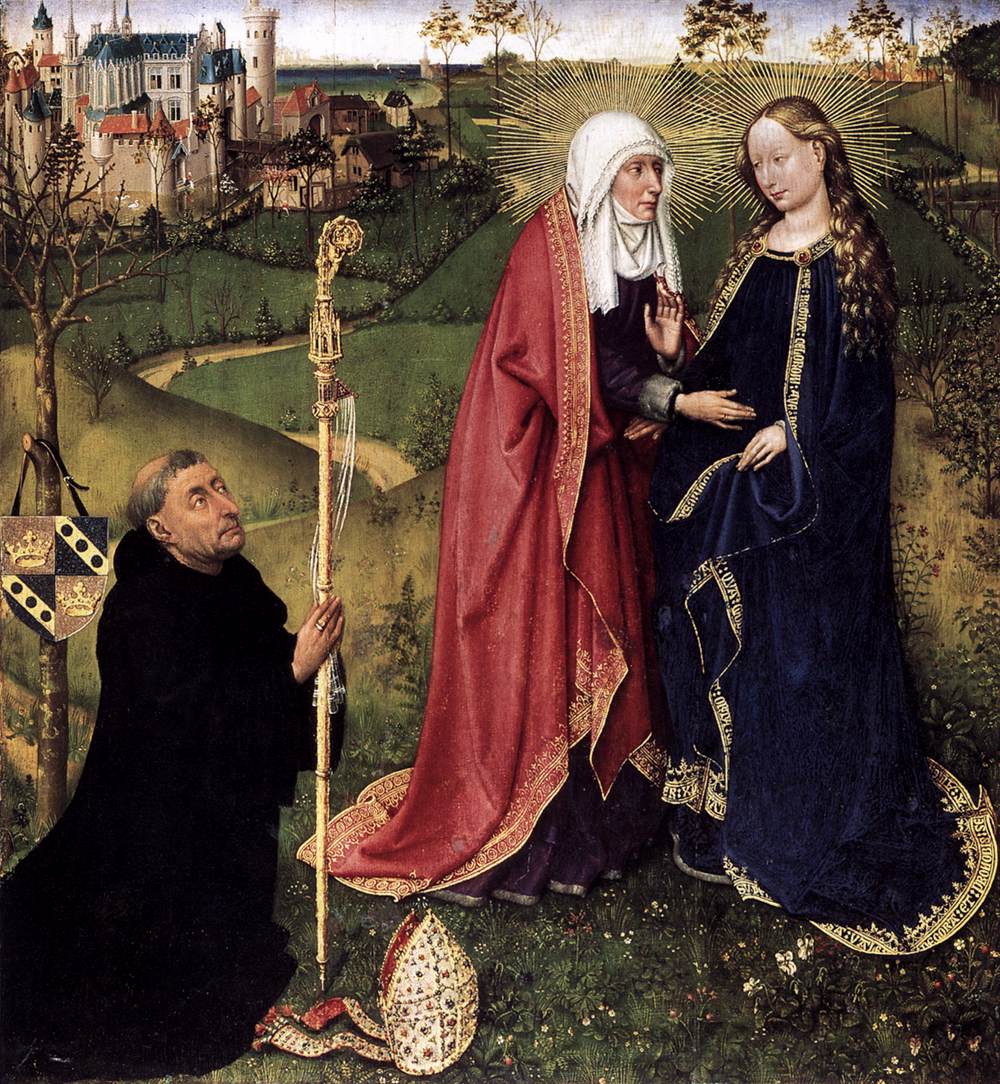
Jacques Daret was Netherlandish painter born at Tournai in around 1403, and, save for a few brief interludes, spent the rest of his life in the city of his birth. He was trained along with Rogelet de la Pature (assumed to be identical with Rogier van der Weyden) in Robert Campin 's studio, where he spent fifteen years or so, before setting up as a master in his own right. Without being a genius in the strict sense of the term, he was yet an excellent artist with a thorough grasp of the techniques of his trade. In many ways, he was quite the equal of his more famous contemporaries, and was above all a supremely talented draughtsman. He was one of the stars of the Burgundian court, and was twice chosen in preference to all competitors when Philip the Good and Charles the Bold were looking for someone to organize a ceremonial occasion. His principal patron over a period of twenty years was the abbot of St Vaart, Jean de Clercq. The numerous works that Jacques Daret produced for the abbot provide an ideal illustration of the range of activity typical of a 15th-century painter. Between 1433 and 1436, Daret painted five polychrome statues for the abbot's funerary monument. He painted the panels for an altarpiece dedicated to the Virgin, as well as colouring the polychrome sculptures and making a protective glass frame in which to enclose the whole to keep it free of dust and dirt. He also painted a series of portraits representing the different abbots of the abbey since its foundation by Theodoric III, King of the Franks. Daret was also a master of the art of illumination. On 8 May 1436, one Éleuthére du Pret engaged him "to teach him the art of illumination'. Yet, out of all of Daret's works that are recorded in Jean de Clercq's account books, only four panels have survived to the present day. They come from an Altarpiece of the Virgin (St Vaast Altarpiece) painted for the abbot between 1433 and 1435. Two of them, the Visitation and the Adoration of the Magi, are in the State Collections in Berlin; the third, the Nativity, is in the Thyssen-Bornemisza collection, and the fourth, the Presentation in the Temple, is in the Petit Palais Museum, in Paris. Unfortunately, all his later work has been either lost or destroyed, and we thus know nothing of how the young painter's career developed after this altarpiece.
View all works →