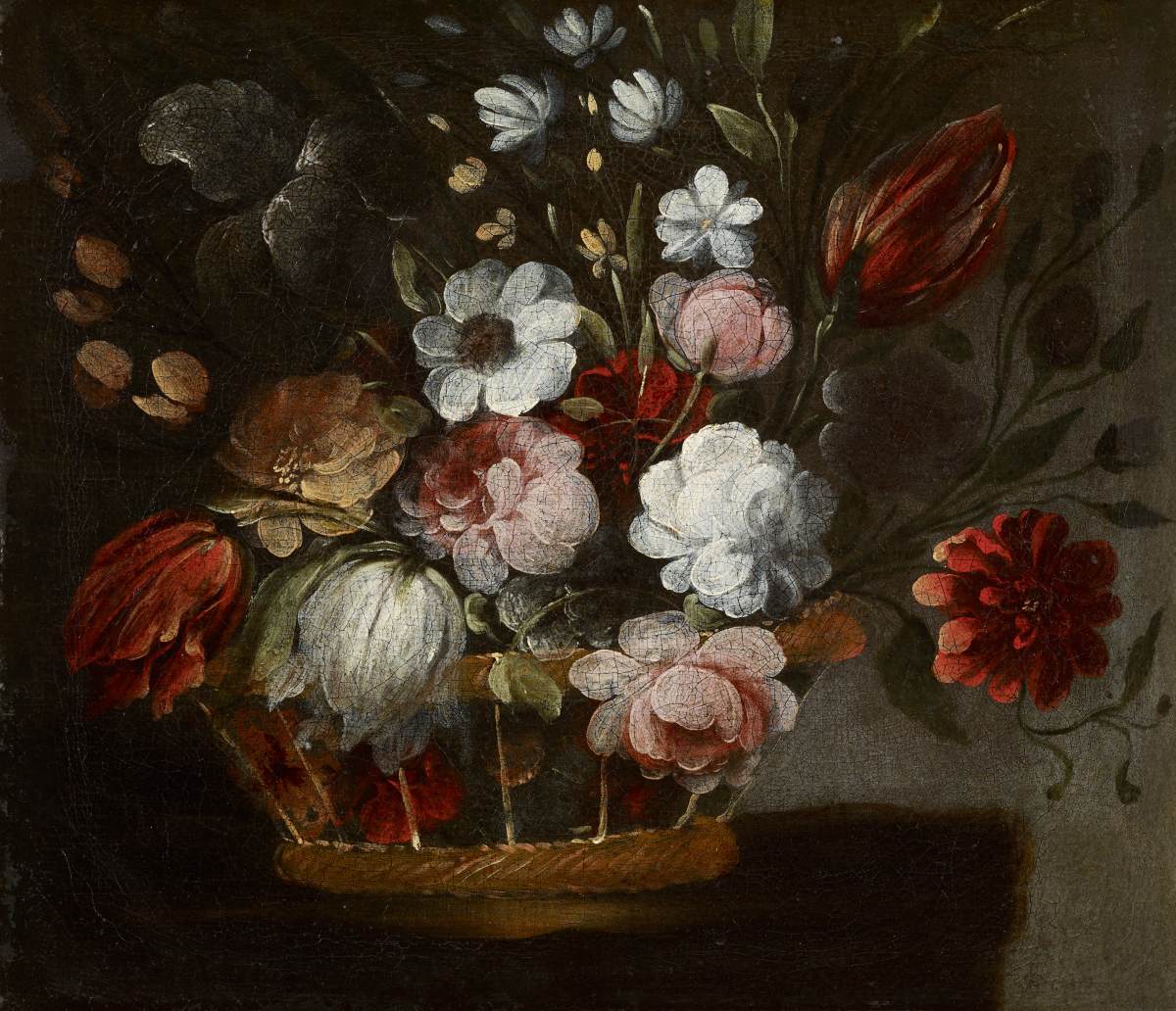
Diego Valentín Díaz
1586 – 1680
Spanish painter and collector. He was the son and pupil of the painter Pedro Díaz Minaya (c. 1555-1624), who worked in Valladolid, the location of Philip III's court from 1600 to 1606. For more than 50 years, Diego Valentín Díaz was Valladolid's most important painter, producing a great number of religious works and portraits containing colourful imagery; many of these are widely dispersed in collections and churches throughout Spain. However, he is likely to have painted still-life and flower paintings over his long career, too. A number of flower paintings mentioned in his post-mortem inventory of 1661 were probably his own work. Although his early works were executed in a style of late Mannerism, he gradually introduced more naturalistic elements, resulting in paintings with precise drawing, a varied but rather dull colouring, an emphasis on decorative details and a sweet expression on the faces of his religious figures. His earliest surviving works are the altarpiece (1608) of the convent of S Catalina, Valladolid, and the Martyrdom of St Sebastian and the Penitent St Peter (both 1610; Zamora, Hospital de la Encarnación). In 1612, with his father and his brothers Francisco Díaz and Marcelo Martínez Díaz, he formed a family workshop. The Holy Family (c. 1621; Museo de la Pasión, Valladolid) is reminiscent of the work of Rubens, while the paintings (e.g. of Martino de San Lorenzo) for the altarpiece of S María de la Corte, Oviedo, use strong chiaroscuro and a naturalistic style. In 1647, by then a well-established artist in Valladolid, he acquired the patronage of Ninas Huerfanas (d. 1653) and helped in the promotion of the fraternity of S Lucas, obtaining commissions to paint their altarpieces. As a portrait painter, he worked for the nobility of Valladolid and painted some of the bishops of the city (e.g. Don Juan Vigil de Quinones, c. 1632; Valladolid Cathedral). He also kept himself well informed about events in Seville and Madrid through his correspondence with Velázquez and Francisco Pacheco and was involved in other preoccupations such as collecting; his collection included engravings by Raphael. His last painting (the Immaculate Conception, c. 1660) was the altarpiece of the Palacio de Campos, Palencia. It was executed mostly by his pupil Bartolomé Santos (fl. 1661), as Díaz died in 1660, the year the contract was drawn up.
View all works →