Adam Elsheimer
1578 – 1610
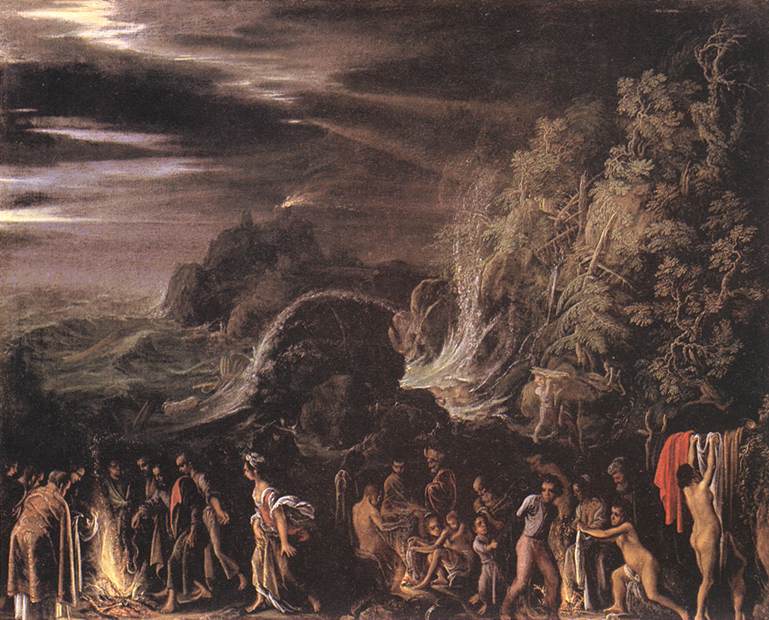
German painter, one of the first masters of the idyllic landscape. He was trained in the dry manner of Flemish realism, but he acquired a liberating interest in light, atmosphere, and color when he settled (1598) in Italy. In Venice he worked with his countryman Rottenhammer, then settled in Rome in 1600. His early Mannerist style gave way to a more direct manner in which he showed great sensitivity to effects of light; his nocturnal scenes are particularly original, bringing out the best in his lyrical temperament, and he is credited with being the first artist to represent the constellations of the night sky accurately (in The Flight into Egypt). He painted a few pictures in which figures predominate, but generally they are fused into a harmonious unity with their landscape settings. They are invariably on a small scale and on copper (the only exception is a self-portrait in the Uffizi, Florence, of doubtful attribution), but although exquisitely executed they have a grandeur out of all proportion to their size. Elsheimer achieved fame during his lifetime and there are numerous contemporary copies of his works. His paintings were engraved by his pupil and patron, the Dutch amateur artist Count Hendrick Goudt (1573-1648), and Elsheimer himself made a number of etchings. In spite of his popularity he was personally unsuccessful and died in poverty. Sandrart says he suffered from melancholia and was often unable to work; apparently he was imprisoned for debt. Rubens was a friend of Elsheimer and after his death lamented his "sin of sloth, by which he has deprived the world of the most beautiful things"; he also wrote "I have never seen his equal in the realm of small figures, of landscapes, and of so many other subjects." Although Elsheimer died young and his output was small he played a key role in the development of 17th-century landscape painting, and his influence is apparent in the work of many other 17th-century artists.
View all works →