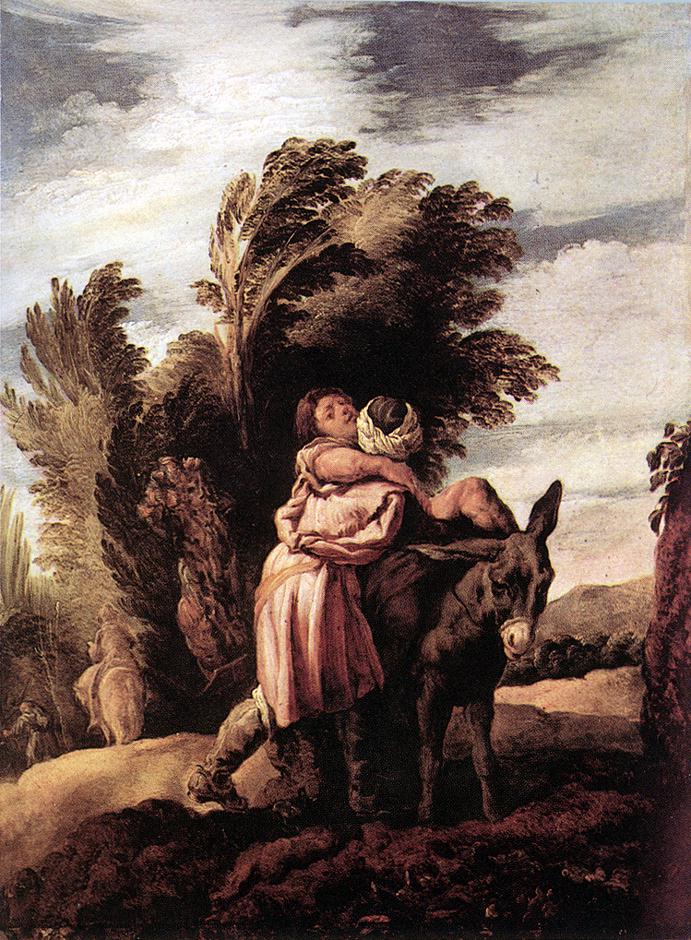
Domenico Fetti
1589 – 1623
Domenico Fetti (or Feti), Italian painter. He was born at Rome, where he studied under Ludovico Cigoli, was court painter to Vincenzo Gonzaga at Mantua from 1613 to 1622, and then settled in Venice. Mantua, this out-of-the-way location allowed him to develop a highly original style of painting where a variety of different influences blended together. He trained during the last days of Mannerism, but he was influenced decisively by Rubens' arrival in Italy. His dialogue with Rubens and more generally his interest in Flemish and Dutch painting gave rise to a rich and luminous way with his brushstrokes. Most of his canvases tended to be fairly small and these are perhaps more interesting than the larger works he produced, such as the frescos in Mantua cathedral or the large lunette showing The Miracle of the Loaves and Fishes in the Pallazzo Ducale in Mantua. He painted a splendid cycle on the Gospel parables for the same princely residence. Unfortunately the pictures have since been split between various museums - Dresden, Vienna, Prague, and Florence. His most characteristic works are of religious themes turned into genre scenes of contemporary life. Though small in scale, they are broadly painted, with characteristic 'windswept' brushstrokes. Their great popularity is shown by the fact that they often exist in numerous very similar versions (e.g. his famous Melancholy). Fetti, who was also an excellent portraitist, was one of a group of non-Venetian artists (including the German Liss and the Genoan Strozzi) who revivified painting in the city when there was a scarcity of native talent. Consequently, he is often classed as a member of the Venetian School, even though he spent only the last two years of his life there.
View all works →