Giambattista Foggini
1652 – 1725
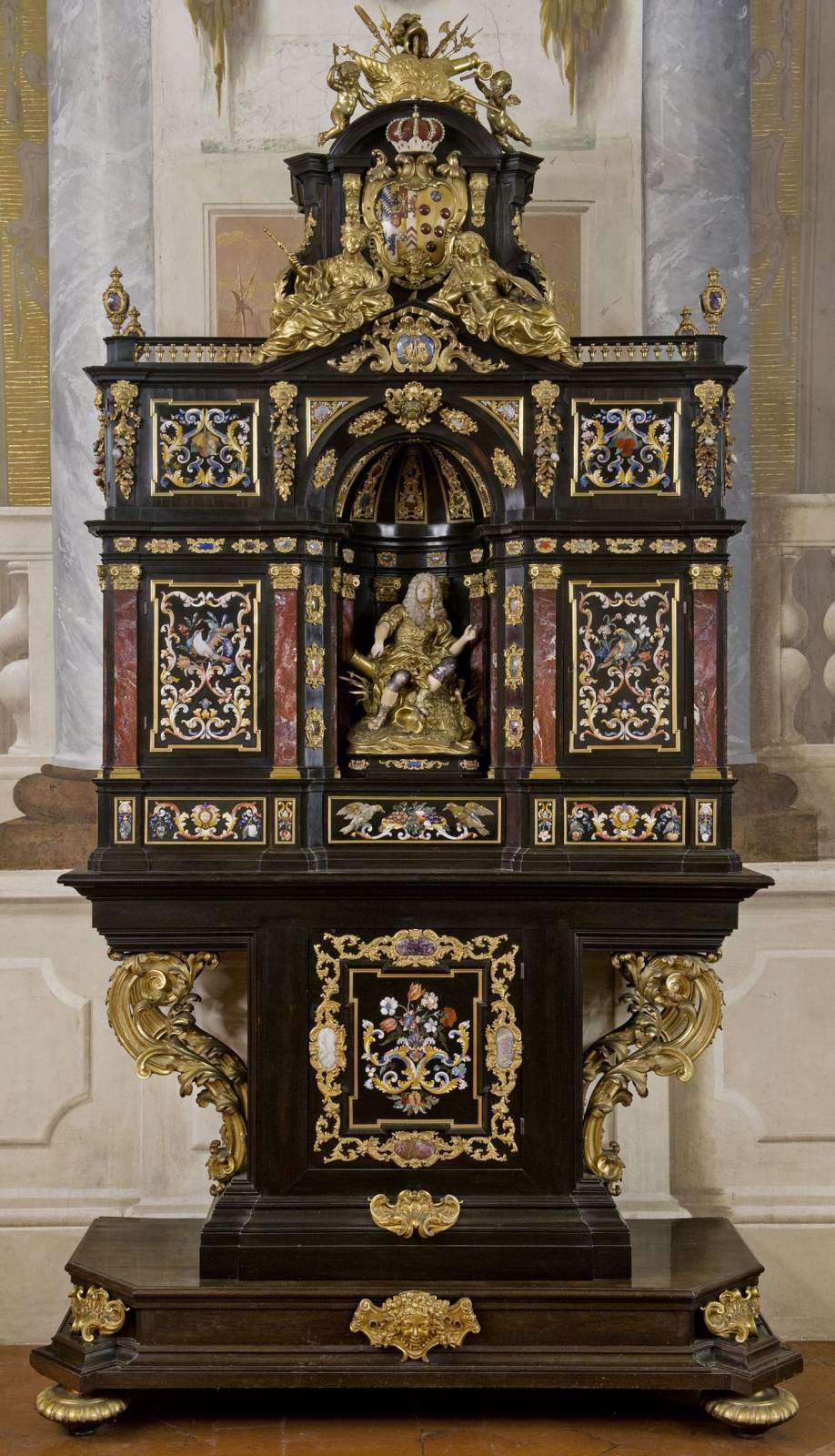
Italian sculptor and architect. The foremost Florentine sculptor of the late Baroque period, he was first apprenticed to two painters successively but soon showed a greater propensity for sculpture. He was sent to Rome as one of the first pupils of the Florentine Academy there by Grand Duke Cosimo III in 1673. His three years' study encompassed drawing with Pietro da Cortona 's former pupil Ciro Ferri as well as modelling and carving with Ercole Ferrata. Among his tasks were the copying of paintings in relief as well as compositions by Ferrata; consequently, Foggini's approach to narrative was indirectly tinctured by examples of Pietro da Cortona and Algardi. His precocious ability at this period is demonstrated in a terracotta relief of the Slaying of the Niobids (Museo Opificio Pietre Dure, Florence); a marble relief of the Adoration of the Shepherds (The Hermitage, St Petersburg); and a bronze relief of the Crucifixion (Palazzo Pitti, Florence), until recently ascribed to the court sculptor of the day, Ferdinando Tacca. These early works established his characteristic style, a novel late Baroque manner that changed little throughout his career. On his return from Rome in 1676, Foggini immediately began to receive commissions for sculpture from the Medici court. A decade later he was appointed grand ducal sculptor, after the death of Tacca, and in 1694 became the court architect as well. From then until his death he was chiefly employed on commissions for the Medici, with Massimiliano Soldani as his only rival. Foggini supervised the grand ducal studio and foundry in Borgo Pinti, which was the centre for official bronze commissions, and also the Galleria dei Lavori (now the Opificio delle Pietre Dure), the manufactory for works in hardstone inlay. He was a prolific and assured draughtsman, and approximately 400 of his designs for sculpture, bronze statuettes, furniture and ornaments involving hardstones have survived. A weak constitution compounded by illness encouraged him to concentrate on bronzes and small-scale works to conserve his strength. However, in the 1680s he decorated the Corsini Chapel of the Santa Maria del Carmine, Florence with large marble reliefs.
View all works →